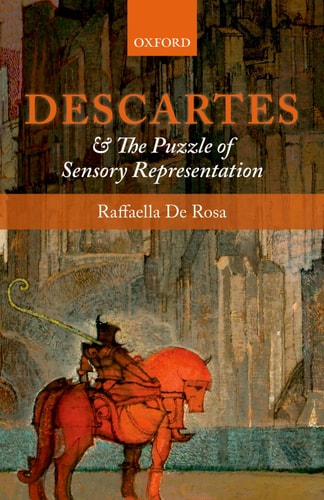
Descartes and the Puzzle of Sensory Representation
0
0
As an Amazon Associate and affiliate partner, Menrva Books earns from qualifying purchases. Learn more
Author Description
While much has been written on Descartes' theory of mind and ideas, no systematic study of his theory of sensory representation and misrepresentation is currently available in the literature. Descartes and the Puzzle of Sensory Misrepresentation is an ambitious attempt to fill this gap. It argues against the established view that Cartesian sensations are mere qualia by defending the view that they are representational; it offers a descriptivist-causal account of their representationality that is critical of, and differs from, all other extant accounts (such as, for example, causal, teleofunctional and purely internalist accounts); and it has the advantage of providing an adequate solution to the problem of sensory misrepresentation within Descartes' internalist theory of ideas. In sum, the book offers a novel account of the representationality of Cartesian sensations; provides a panoramic overview, and critical assessment, of the scholarly literature on this issue; and places Descartes' theory of sensation in the central position it deserves among the philosophical and scientific investigations of the workings of the human mind.
Menrva's Summary
THE THESIS
This book investigates the core question of how Descartes’ theory of sensory representation accounts for the phenomenon of misrepresentation within his internalist framework. Raffaella De Rosa, a scholar specializing in early modern philosophy, challenges the traditional interpretation that Cartesian sensations are merely qualia. She proposes a descriptivist-causal account of representationality, arguing that sensations function as representational states that can be evaluated for accuracy, thereby addressing a significant gap in Cartesian scholarship.
THE SCOPE MAP
What You Will Find
- A systematic analysis of Cartesian sensory representation and misrepresentation.
- A comparative critique of existing causal, teleofunctional, and internalist accounts.
- A novel descriptivist-causal framework for interpreting Cartesian ideas.
Scope Limits
- The study focuses specifically on the internalist theory of ideas rather than broader Cartesian physics or metaphysics.
- It does not provide a general biography of Descartes or a comprehensive history of 17th-century science.
THE AUTHORITY PERSPECTIVE
Scholars recognize this work as a significant contribution to the study of Cartesian philosophy, particularly for its rigorous challenge to the standard qualia-based interpretation. Readers frequently note the academic density of the prose, which is intended for advanced students and researchers in the field of early modern philosophy.
Page Count:
204
Publication Date:
2010-01-01
Publisher:
OUP Oxford
ISBN-10:
0191610062
ISBN-13:
9780191610066
Philosophy
René Descartes
Philosophy history
Mind & Body
Philosophy of
Epistemology