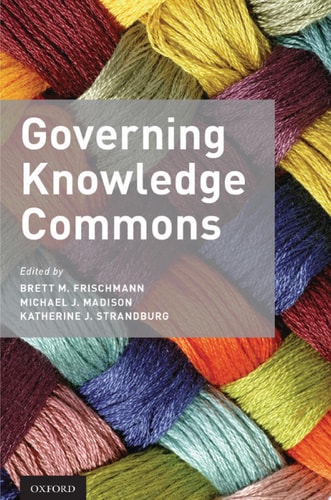
Governing Knowledge Commons
0
0
As an Amazon Associate and affiliate partner, Menrva Books earns from qualifying purchases. Learn more
Author Description
"Knowledge commons" describes the institutionalized community governance of the sharing and, in some cases, creation, of information, science, knowledge, data, and other types of intellectual and cultural resources. It is the subject of enormous recent interest and enthusiasm with respect to policymaking about innovation, creative production, and intellectual property. Taking that enthusiasm as its starting point, Governing Knowledge Commons argues that policymaking should be based on evidence and a deeper understanding of what makes commons institutions work. It offers a systematic way to study knowledge commons, borrowing and building on Elinor Ostrom's Nobel Prize-winning research on natural resource commons. It proposes a framework for studying knowledge commons that is adapted to the unique attributes of knowledge and information, describing the framework in detail and explaining how to put it into context both with respect to commons research and with respect to innovation and information policy. Eleven detailed case studies apply and discuss the framework exploring knowledge commons across a wide variety of scientific and cultural domains.
Menrva's Summary
THE THESIS
This book investigates how institutionalized community governance can effectively manage the sharing and creation of intellectual and cultural resources. The authors, Brett M. Frischmann, Katherine J. Strandburg, and Michael J. Madison, leverage their expertise in law and policy to adapt Elinor Ostrom’s Nobel Prize-winning research on natural resource commons to the digital and intellectual sphere. They argue that effective innovation policy must move beyond abstract enthusiasm and instead rely on a rigorous, evidence-based framework for understanding how knowledge commons function in practice.
THE SCOPE MAP
What You Will Find
- A systematic analytical framework for studying knowledge commons adapted from natural resource management.
- Eleven detailed case studies covering diverse scientific and cultural domains.
- Methodologies for evaluating the sustainability and productivity of information-sharing communities.
- Theoretical integration of innovation policy with institutional governance research.
THE AUTHORITY PERSPECTIVE
Experts recognize this work as a foundational text for scholars and policymakers interested in the intersection of intellectual property and community governance. Readers frequently note the academic density of the prose, which serves as a rigorous guide for those applying the authors' framework to real-world institutional analysis.
Page Count:
520
Publication Date:
2014-08-05
Publisher:
Oxford University Press
ISBN-10:
0199972044
ISBN-13:
9780199972043
Economics
Sociology
Professional Career & Trade
Intellectual Property
Communities
Information Science
Law
Reference
Public Policy
Community Tags
Similar Books