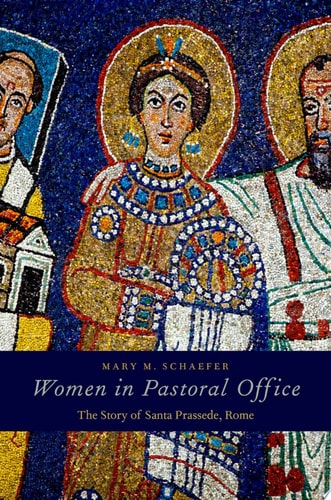
Women in Pastoral Office: The Story of Santa Prassede, Rome
0
0
As an Amazon Associate and affiliate partner, Menrva Books earns from qualifying purchases. Learn more
Author Description
Through a study of the church of Santa Prassede, Mary M. Schaefer offers a compelling examination of the ''golden ages'' for women active in ecclesial ministries, critically measuring feminist claims and providing evidence contrary to the official Roman position that women have never been ordained in the Catholic Church. The ninth-century church of Santa Prassede has been studied intensively in recent years, yet no scholar has yet recognized the significance of the balanced male and female imagery: both men and women disciples, Peter and Paul as family friends, Praxedes and her sister as house church leaders in the post-apostolic period assisted by bishop Pius I, and Pope Paschal's mother Theodora episcopa, for example. Praxedes' identification as ''presbytera'' by a Roman priest-historian in 1655 and by the Benedictine prior of the church in 1725 prompts analysis of women's ordination rites in churches of East and West. Santa Prassede preserves one of the largest intact programs of church decoration in Rome up to 1200. Schaefer investigates its scriptural and liturgical sources, and, in turn, reexamines its foundation myth. With the story of the church, Schaefer provides a detailed study of women in pastoral office (especially diaconas, presbyteras, and episcopal abbesses) from the first through twelfth centuries in the West. Women in Pastoral Office also shows how the liturgy as well as the vita of Praxedes and her sister Pudentiana (whose fourth century church is located down the hill) shaped this outstanding commission of the builder, Pope Paschal I (817-824).
Menrva's Summary
THE THESIS
This book investigates the historical evidence for women holding pastoral offices within the early and medieval Catholic Church, challenging the official position that women have never been ordained. Mary M. Schaefer, a scholar of liturgy and church history, utilizes the architectural and artistic evidence found within the ninth-century Roman church of Santa Prassede to construct her argument. By analyzing the site's iconography, liturgical sources, and foundation myths, she presents a case for the historical presence of women in roles such as diaconas, presbyteras, and episcopal abbesses between the first and twelfth centuries.
THE SCOPE MAP
What You Will Find
- An analysis of the ninth-century church of Santa Prassede as a primary historical document.
- Examination of the roles of women in pastoral office, including diaconas, presbyteras, and episcopal abbesses.
- A critical review of the historical identification of figures like Theodora episcopa and Praxedes.
- A study of the intersection between liturgical sources, church decoration, and the evolution of ordination rites in the West.
THE AUTHORITY PERSPECTIVE
Scholars and readers acknowledge this work as a significant contribution to the study of women's roles in early church history, particularly for its focus on material culture and art history. The text is noted for its academic rigor and its detailed examination of specific Roman ecclesiastical sites as evidence for broader historical claims.
Page Count:
496
Publication Date:
2013-01-01
Publisher:
Oxford University Press
ISBN-10:
0199977631
ISBN-13:
9780199977635
History
Religion
Professional Career & Trade
Art History
Rome Italy
Women Clergy
Clergy
Ecclesiology
Italy history
Catholicism
Technology Design
Liturgics
Women Studies
Community Tags
Similar Books