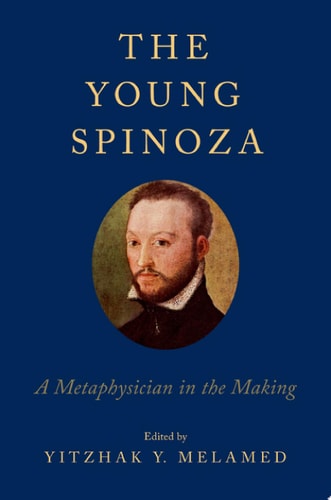
The Young Spinoza: A Metaphysician in the Making
0
0
As an Amazon Associate and affiliate partner, Menrva Books earns from qualifying purchases. Learn more
Author Description
Ex nihilo nihil fit. Philosophy, especially great philosophy, does not appear out of the blue. In the current volume, a team of top scholars-both up-and-coming and established-attempts to trace the philosophical development of one of the greatest philosophers of all time. Featuring twenty new essays and an introduction, it is the first attempt of its kind in English and its appearance coincides with the recent surge of interest in Spinoza in Anglo-American philosophy.Spinoza's fame-or notoriety-is due primarily to his posthumously published magnum opus, the Ethics, and, to a lesser extent, to the 1670 Theological-Political Treatise. Few readers take the time to study his early works carefully. If they do, they are likely to encounter some surprising claims, which often diverge from, or even utterly contradict, the doctrines of the Ethics. Consider just a few of these assertions: that God acts from absolute freedom of will, that God is a whole, that there are no modes in God, that extension is divisible and hence cannot be an attribute of God, and that the intellectual and corporeal substances are modes in relation to God. Yet, though these claims reveal some tension between the early works and the Ethics, there is also a clear continuity between them.Spinoza wrote the Ethics over a long period of time, which spanned most of his philosophical career. The dates of the early drafts of the Ethics seem to overlap with the assumed dates of the composition of the Treatise on the Emendation of the Intellect and the Short Treatise on God, Man, and His Well Being and precede the publication of Spinoza's 1663 book on Descartes' Principles of Philosophy. For this reason, a study of Spinoza's early works (and correspondence) can illuminate the nature of the problems Spinoza addresses in the Ethics, insofar as the views expressed in the early works help us reconstruct the development and genealogy of the Ethics. Indeed, if we keep in mind the common dictum "nothing comes from nothing."
Menrva's Summary
THE THESIS
This volume investigates the intellectual genealogy of Baruch Spinoza by examining the evolution of his philosophical doctrines from his early writings to his mature magnum opus, the Ethics. Editor Yitzhak Y. Melamed, a prominent scholar of early modern philosophy, assembles a collection of twenty essays from leading experts to reconstruct the development of Spinoza's thought. The contributors analyze early texts, such as the Short Treatise on God, Man, and His Well Being, to identify both the tensions and the continuities that shaped his final metaphysical framework.
THE SCOPE MAP
What You Will Find
- Comparative analysis of early drafts versus the final Ethics.
- Examination of Spinoza's engagement with Cartesian principles.
- Scholarly investigation into the development of Spinoza's views on substance, attributes, and modes.
- Contextualization of Spinoza's early correspondence and its impact on his later philosophical trajectory.
THE AUTHORITY PERSPECTIVE
Scholars recognize this collection as a significant contribution to Spinoza studies, particularly for its focus on the often-overlooked early period of his career. The text is noted for its academic rigor and is considered a valuable resource for those seeking to understand the historical and logical foundations of Spinoza's mature philosophy.
Page Count:
384
Publication Date:
2015-01-01
Publisher:
Oxford University Press
ISBN-10:
0199971684
ISBN-13:
9780199971688
History
Philosophy
Biography
Philosophers - Biography
Intellectual History
Netherlands biography
Biography Autobiography
History & Surveys
Metaphysics
English & College Success
English
Community Tags
Similar Books