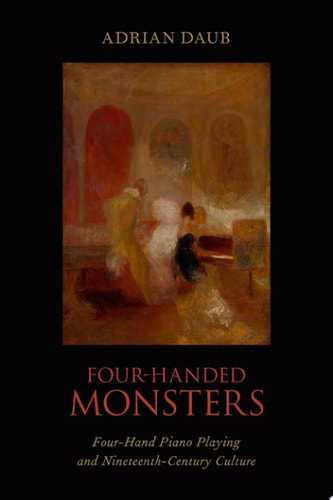
Four-Handed Monsters: Four-Hand Piano Playing and Nineteenth-Century Culture
0
0
As an Amazon Associate and affiliate partner, Menrva Books earns from qualifying purchases. Learn more
Author Description
In the course of the nineteenth century, four-hand piano playing emerged across Europe as a popular pastime of the well-heeled classes and of those looking to join them. Nary a canonic work of classical music that was not set for piano duo, nary a house that could afford not to invest in them. Duets echoed from the student bedsit to Buckingham Palace, resounded in schools and in hundreds of thousands of bourgeois parlors. Like no other musical phenomenon, it could cross national, social, and economic boundaries, bringing together poor students with the daughters of the bourgeoisie, crowned heads with penniless virtuosi, and the nineteenth century often regarded it with extreme suspicion for that very reason. Four-hand piano playing was often understood as a socially acceptable way of flirting, a flurry of hands that made touching, often of men and women, not just acceptable but necessary. But it also became something far more serious than that, a central institution of the home, mediating between inside and outside, family and society, labor and leisure, nature and nurture. And writers, composers, musicians, philosophers, journalists, pamphleteers and painters took note: in the art, literature, and philosophy of the age, four-hand playing emerged as a common motif, something that allowed them to interrogate the very nature of the self, the family, the community and the state. In the four hands rushing up and down the same keyboard the nineteenth century espied, or thought to espy, an astonishing array of things. Four-Handed Monsters tells not only the story of that practice, but also the story of the astonishing array of things the nineteenth century read into it.
Menrva's Summary
THE THESIS
How did the practice of four-hand piano playing function as a critical site for negotiating social, gender, and political anxieties in nineteenth-century Europe? Adrian Daub, a scholar of German literature and musicology, examines the ubiquity of piano duets to argue that this domestic musical activity served as a complex mediator between private life and public identity. By analyzing a wide range of primary sources including literature, journalism, and visual art, the author demonstrates how the physical proximity required by the duet format became a focal point for contemporary debates regarding morality, class structure, and the nature of the self.
THE SCOPE MAP
What You Will Find
- Historical analysis of the rise of piano duets in nineteenth-century European domestic spaces.
- Examination of the social and moral implications of physical proximity between duet partners.
- Integration of literary, philosophical, and artistic representations of four-hand performance.
- Investigation into how musical practice intersected with class boundaries and gender roles.
THE AUTHORITY PERSPECTIVE
Scholars and music historians frequently cite this work for its interdisciplinary approach to nineteenth-century cultural history. Readers often note the academic density of the prose, which effectively connects musical performance to broader sociological shifts of the era.
Page Count:
257
Publication Date:
2014-01-01
Publisher:
Oxford University Press
ISBN-10:
0199981809
ISBN-13:
9780199981809
Music
History
Nineteenth century
Criticism history
Social History
Humanities
Community Tags
Similar Books