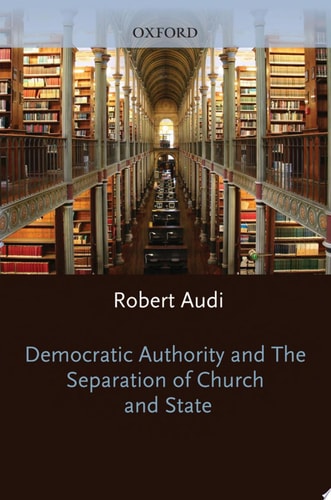
Democratic Authority and the Separation of Church and State
0
0
As an Amazon Associate and affiliate partner, Menrva Books earns from qualifying purchases. Learn more
Author Description
Democratic states must protect the liberty of citizens and must accommodate both religious liberty and cultural diversity. This democratic imperative is one reason for the increasing secularity of most modern democracies. Religious citizens, however, commonly see a secular state as unfriendly toward religion. This book articulates principles that enable secular governments to protect liberty in a way that judiciously separates church and state and fully respects religious citizens.After presenting a brief account of the relation between religion and ethics, the book shows how ethics can be independent of religion-evidentially autonomous in a way that makes moral knowledge possible for secular citizens--without denying religious sources a moral authority of their own. With this account in view, it portrays a church-state separation that requires governments not only to avoid religious establishment but also to maintain religious neutrality. The book shows how religious neutrality is related to such issues as teaching evolutionary biology in public schools, the legitimacy of vouchers to fund private schooling, and governmental support of "faith-based initiatives." The final chapter shows how the proposed theory of religion and politics incorporates toleration and forgiveness as elements in flourishing democracies. Tolerance and forgiveness are described; their role in democratic citizenship is clarified; and in this light a conception of civic virtue is proposed. Overall, the book advances the theory of liberal democracy, clarifies the relation between religion and ethics, provides distinctive principles governing religion in politics, and provides a theory of toleration for pluralistic societies. It frames institutional principles to guide governmental policy toward religion; it articulates citizenship standards for political conduct by individuals; it examines the case for affirming these two kinds of standards on the basis of what, historically, has been called nat
Menrva's Summary
THE THESIS
This book investigates how democratic states can maintain a principled separation of church and state while simultaneously respecting the religious liberty and moral contributions of their citizens. Robert Audi, a prominent philosopher, utilizes a framework of liberal democracy to argue for a secular government that remains neutral toward religion. He posits that moral knowledge is accessible to secular citizens through autonomous ethics, while still acknowledging the validity of religious moral authority, ultimately proposing a set of standards for both institutional policy and individual political conduct.
THE SCOPE MAP
What You Will Find
- A theoretical framework for the separation of church and state based on religious neutrality.
- Analysis of specific public policy issues including evolutionary biology in schools, school vouchers, and faith-based initiatives.
- A philosophical exploration of the roles of toleration, forgiveness, and civic virtue in pluralistic societies.
Scope Limits
- The text focuses primarily on Western liberal democratic models and does not provide an exhaustive global survey of all theocratic or non-democratic governance systems.
THE AUTHORITY PERSPECTIVE
Scholars and political theorists frequently cite this work as a rigorous contribution to the discourse on secularism and political ethics. Readers often note the academic density of the prose, which requires a foundational understanding of moral philosophy to fully grasp the author's arguments.
Page Count:
194
Publication Date:
2011-01-01
Publisher:
Oxford University Press
ISBN-10:
0190208147
ISBN-13:
9780190208141
Philosophy
Secularism
Ethics
Democracy
Religion and Politics
Religious Aspects
Community Tags
Other Editions(4)
Similar Books




Reader Comments
Share Your Thoughts
No comments yet. Be the first to share your thoughts!