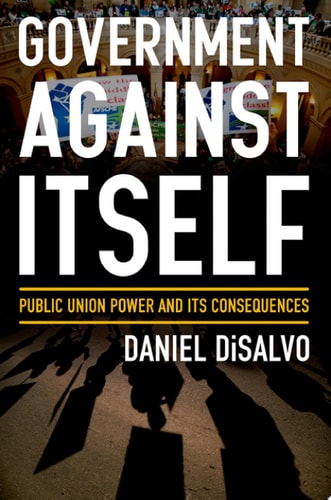
Government against Itself: Public Union Power and Its Consequences
0
0
As an Amazon Associate and affiliate partner, Menrva Books earns from qualifying purchases. Learn more
Author Description
As workers in the private sector struggle with stagnant wages, disappearing benefits, and rising retirement ages, unionized public employees retire in their fifties with over $100,000 a year in pension and healthcare benefits. The unions defend tooth and nail the generous compensation packages and extensive job security measures they've won for their members. However, the costs they impose crowd out important government services on which the poor and the middle class rely. Attempts to rein in the unions, as in Wisconsin and New Jersey, have met with massive resistance. Yet as Daniel DiSalvo argues in Government against Itself, public sector unions threaten the integrity of our very democracy. DiSalvo, a third generation union member, sees the value in private sector unions. But in public sector, unions do not face a genuine adversary at the bargaining table. Moreover, the public sector can't go out of business no matter how much union members manage to squeeze out of it. Union members have no incentive to settle for less, and the costs get passed along to the taxpayer. States and municipalities strain under the weight of their pension obligations, and the chasm between well-compensated public sector employees and their beleaguered private sector counterparts widens. Where private sector unions can provide a necessary counterweight to the power of capital, public employee unionism is basically the government bargaining with itself; it's no wonder they almost always win. The left is largely in thrall to the unions, both ideologically and financially; the right would simply take a hatchet to the state itself, eliminating important and valuable government services. Neither side offers a realistic vision of well-run government that spends tax dollars wisely and serves the public well. Moving beyond stale and unproductive partisan divisions, DiSalvo argues that we can build a better, more responsive government that is accountable to taxpayers. But we cannot do it until we
Menrva's Summary
THE THESIS
This book investigates the systemic imbalance created by public sector unions and the resulting consequences for government fiscal health and democratic integrity. Daniel DiSalvo, a scholar of American politics, utilizes historical analysis and economic data to argue that public sector unions operate under a fundamentally different incentive structure than their private sector counterparts. By examining the lack of a genuine adversary at the bargaining table, he posits that these unions exert disproportionate influence over taxpayer-funded compensation and pension obligations. The work serves as a critique of current labor practices and proposes a framework for re-establishing government accountability to the public.
THE SCOPE MAP
What You Will Find
- Analysis of the structural differences between private and public sector collective bargaining.
- Examination of the fiscal impact of public employee pension and healthcare obligations on state and municipal budgets.
- Evaluation of the political influence of unions on government policy and partisan dynamics.
- Proposed strategies for balancing union interests with taxpayer accountability and efficient service delivery.
THE AUTHORITY PERSPECTIVE
Experts and political analysts frequently cite this work as a significant contribution to the debate over public sector labor reform. Readers often note the clarity of the author's argument, which bridges the gap between complex economic data and accessible political commentary.
Page Count:
304
Publication Date:
2014-01-01
Publisher:
Oxford University Press
ISBN-10:
019999076X
ISBN-13:
9780199990764
Economics
United States
Government
American Government
Labor unions
National
Public Policy
Community Tags
Other Editions(2)

Similar Books



Reader Comments
Share Your Thoughts
No comments yet. Be the first to share your thoughts!