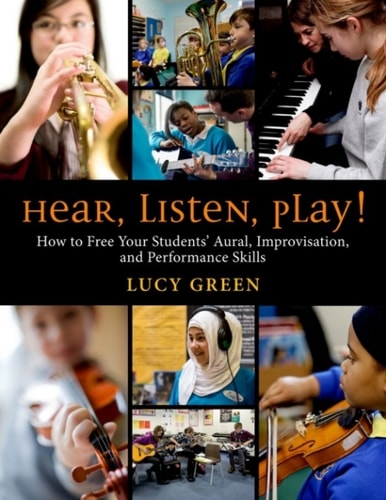
Hear, Listen, Play!: How to Free Your Students' Aural, Improvisation, and Performance Skills
0
0
As an Amazon Associate and affiliate partner, Menrva Books earns from qualifying purchases. Learn more
Author Description
Hear, Listen, Play! is a book for all music teachers who are unfamiliar with, yet curious about the worlds of ear-playing, informal learning, improvisation, and vernacular musics. For decades, or even hundreds of years, a divide has slowly been developing between the realms of notation-based musical transmission, and aural/oral methods. Yet that divide is by no means a necessary aspect of music learning, and musicians who are lucky enough to dwell on both sides of it count themselves as so much the richer for doing so. This book aims to provide a door into those other worlds for any teacher who would like to open it. Starting with a brief discussion of how popular musicians learn in the informal realm, the book then applies many aspects of their learning practices to three main areas within music education. Firstly it tackles the one-to-one specialist instrumental lesson, then ensemble work such as band and orchestra; and finally the generalist or specialist classroom. The methods within each section have been systematically tried and tested in research projects spanning more than a decade, yet the book is written in simple, non-academic language which teachers will quickly find applicable to their working lives. Vignettes from the research participants themselves provide color throughout the book, and give illustrations of how both teachers and learners have experienced the methods themselves. This book is not a prescription for one particular way of teaching or learning; it does not aim to critique, replace or change the excellent practices that are already on-going in the diverse world of music education and pedagogy. It simply offers something which is likely to be new to many teachers, and which they can, if they so wish, add in to the mix. The professional judgment and expertise of the teacher is surely the lynch-pin on which all good teaching relies; and the open nature of this book, along with its frequent calls for teachers to not only adopt, but adapt, its
Menrva's Summary
THE THESIS
How can music educators bridge the divide between formal notation-based instruction and informal, aural-based learning practices? Lucy Green, a prominent researcher in music pedagogy, argues that traditional music education often neglects the intuitive, ear-based methods used by popular musicians. By synthesizing over a decade of research, she provides a framework for teachers to integrate improvisation and informal learning into diverse educational settings without abandoning established classical techniques.
THE SCOPE MAP
What You Will Find
- Analysis of informal learning practices used by popular musicians.
- Methodologies for applying aural skills in one-to-one instrumental lessons.
- Strategies for incorporating improvisation and ear-playing into ensemble settings like bands and orchestras.
- Practical applications for generalist and specialist classroom environments.
- Qualitative vignettes and case studies from research participants illustrating real-world implementation.
THE AUTHORITY PERSPECTIVE
Educators frequently cite this work as a highly accessible bridge between academic theory and practical classroom application. Experts highlight the book's non-prescriptive tone, noting that it serves as a flexible resource for teachers looking to expand their pedagogical toolkit rather than replace their existing methods.
Page Count:
156
Publication Date:
2013-01-01
Publisher:
Oxford University Press
ISBN-10:
0199995788
ISBN-13:
9780199995783
Humanities
Music theory
Music Education
Teaching Methods
Pedagogy
Improvisation
Music
Community Tags
Other Editions(2)

Similar Books




Reader Comments
Share Your Thoughts
No comments yet. Be the first to share your thoughts!