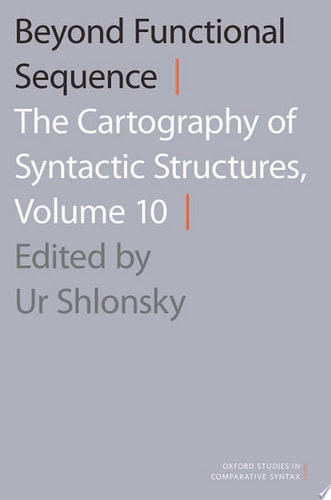
Beyond Functional Sequence: The Cartography of Syntactic Structures
0
0
As an Amazon Associate and affiliate partner, Menrva Books earns from qualifying purchases. Learn more
Author Description
Cartography Is A Research Program Within Syntactic Theory That Studies The Syntactic Structures Of A Particular Language In Order To Better Understand The Semantic Issues At Play In That Language. The Approach Arranges A Language's Morpho-syntactic Features In A Rigid Universal Hierarchy, And Its Research Agenda Is To Describe This Hierarchy -- That Is, To Draw Maps Of Syntactic Configurations. Current Work In Cartography Is Both Empirical -- Extending The Approach To New Languages And New Structures -- And Theoretical. The 16 Articles In This Collection Will Advance Both Dimensions. They Arise From Presentations Made At The Syntactic Cartography: Where Do We Go From Here? Colloquium Held At The University Of Geneva In June Of 2012 And Address Three Questions At The Core Of Research In Syntactic Cartography: 1. Where Do The Contents Of Functional Structure Come From? 2. What Explains The Particular Order Or Hierarchy In Which They Appear? 3. What Are The Computational Restrictions On The Activation Of Functional Categories? Grouped Thematically Into Four Sections, The Articles Address These Questions Through Comparative Studies Across Various Languages, Such As Italian, Old Italian, Hungarian, English, Jamaican Creole, Japanese, And Chinese, Among Others.
Menrva's Summary
THE THESIS
This volume investigates the theoretical foundations and empirical applications of the cartographic research program within syntactic theory. Ur Shlonsky, a prominent scholar in generative syntax, compiles research from the 2012 University of Geneva colloquium to address the origins, hierarchical ordering, and computational constraints of functional categories in human language. The text serves as a scholarly examination of how morpho-syntactic features are mapped across diverse linguistic systems.
THE SCOPE MAP
What You Will Find
- Comparative analyses of syntactic structures in languages including Italian, Hungarian, English, and Japanese.
- Theoretical frameworks addressing the activation of functional categories.
- Empirical studies on the universal hierarchy of morpho-syntactic features.
Scope Limits
- The text does not provide a comprehensive introductory overview for those unfamiliar with generative grammar.
- It focuses specifically on the cartographic approach rather than alternative syntactic theories.
THE AUTHORITY PERSPECTIVE
Experts recognize this collection as a significant contribution to the ongoing development of the cartographic research program. Readers frequently note the high level of academic density and the specialized knowledge required to engage with the technical arguments presented in the articles.
Page Count:
320
Publication Date:
2015-01-01
Publisher:
Oxford University Press, Incorporated
ISBN-10:
0190210605
ISBN-13:
9780190210601
Linguistics
Reference
Academic
Functionalism linguistics
Grammar
Syntax
Community Tags
Other Editions(2)
Similar Books