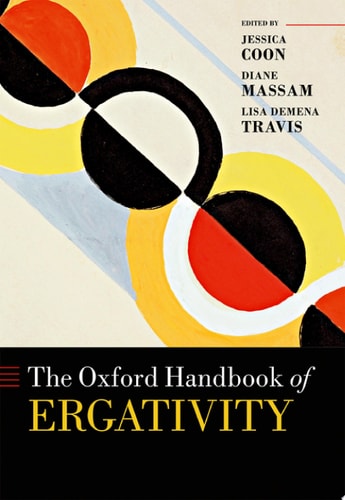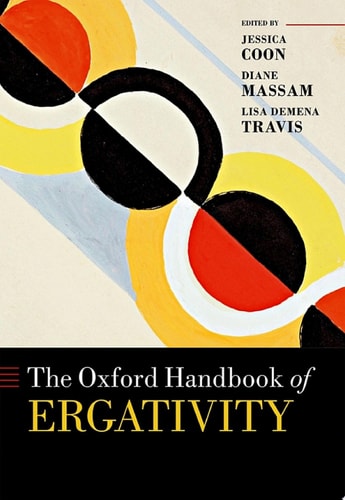
The Oxford Handbook of Ergativity
0
0
As an Amazon Associate and affiliate partner, Menrva Books earns from qualifying purchases. Learn more
Author Description
This volume offers theoretical and descriptive perspectives on the issues pertaining to ergativity, a grammatical patterning whereby direct objects are in some way treated like intransitive subjects, to the exclusion of transitive subjects. This pattern differs markedly from nominative/accusative marking whereby transitive and intransitive subjects are treated as one grammatical class, to the exclusion of direct objects. While ergativity is sometimes referred to as a typological characteristic of languages, research on the phenomenon has shown that languages do not fall clearly into one category or the other and that ergative characteristics are not consistent across languages. Chapters in this volume look at approaches to ergativity within generative, typological, and functional paradigms, as well as approaches to the core morphosyntactic building blocks of an ergative construction; related constructions such as the anti-passive; related properties such as split ergativity and word order; and extensions and permutations of ergativity, including nominalizations and voice systems. The volume also includes results from experimental investigations of ergativity, a relatively new area of research. A wide variety of languages are represented, both in the theoretical chapters and in the 16 case studies that are more descriptive in nature, attesting to both the pervasiveness and diversity of ergative patterns.
Menrva's Summary
THE THESIS
This volume investigates the complex grammatical phenomenon of ergativity, examining how languages categorize subjects and objects in ways that diverge from standard nominative/accusative patterns. The editors, Jessica Coon, Lisa deMena Travis, and Diane Massam, curate a collection of scholarly contributions that synthesize generative, typological, and functional linguistic paradigms. By analyzing the morphosyntactic building blocks of ergative constructions, the text provides a rigorous framework for understanding the diversity and inconsistency of these patterns across global language families.
THE SCOPE MAP
What You Will Find
- Theoretical analysis of ergative, anti-passive, and split-ergative constructions
- Comparative studies on word order, nominalizations, and voice systems
- 16 descriptive case studies covering a diverse range of world languages
- Experimental investigations into the cognitive and structural aspects of ergativity
Scope Limits
- Does not provide a comprehensive dictionary of all known ergative languages
- Excludes introductory-level linguistic theory, assuming a baseline knowledge of syntax and morphology
THE AUTHORITY PERSPECTIVE
Experts identify this volume as a comprehensive reference work that successfully bridges the gap between theoretical generative models and empirical descriptive linguistics. Readers frequently note the high academic density of the prose, which serves as a standard resource for researchers and advanced students in the field of syntax.
Page Count:
1284
Publication Date:
2017-01-01
Publisher:
OUP Oxford
ISBN-10:
0191059781
ISBN-13:
9780191059780
Syntax
Academic
Typology
Morphology
Reference
English
Grammar
Linguistics
English & College Success