
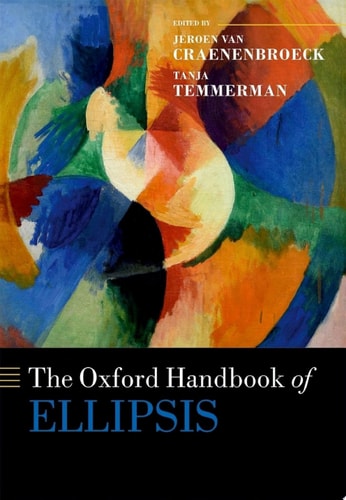
The Oxford Handbook of Ellipsis
0
0
As an Amazon Associate and affiliate partner, Menrva Books earns from qualifying purchases. Learn more
Author Description
This Handbook is the first volume to provide a comprehensive, in-depth, and balanced discussion of ellipsis phenomena, whereby the meaning of an utterance is richer than would be expected based solely on its linguistic form. Natural language abounds in these apparently incomplete expressions, such as I laughed but Ed didn't, in which the final portion of the sentence, the verb 'laugh', remains unpronounced but is still understood. The range of phenomena involved raise general and fundamental questions about the workings of grammar, but also constitute a treasure trove of fine-grained points of inter- and intralinguistic variation. The volume is divided into four parts. In the first, authors examine the role that ellipsis plays and how it is analysed in different theoretical frameworks and linguistic subdisciplines, such as HPSG, Construction Grammar, Inquisitive Semantics, and computational linguistics. Chapters in the second part highlight the usefulness of ellipsis as a diagnostic tool for other linguistic phenomena including movement and islands and codeswitching, while Part III focuses instead on the types of elliptical constructions found in natural language, such as sluicing, gapping, and null complement anaphora. Finally, the last part of the book contains case studies that investigate elliptical phenomena in a wide variety of languages, including Dutch, Japanese, Persian, and Finnish Sign Language.
Menrva's Summary
THE THESIS
This volume investigates the fundamental question of how ellipsis phenomena function within natural language, where the semantic content of an utterance exceeds its explicit linguistic form. Editors Jeroen van Craenenbroeck and Tanja Temmerman compile contributions from leading researchers to provide a comprehensive framework for understanding how unpronounced elements are recovered and interpreted in diverse grammatical systems.
THE SCOPE MAP
What You Will Find
- Theoretical analyses across HPSG, Construction Grammar, and Inquisitive Semantics
- Ellipsis as a diagnostic tool for movement, islands, and codeswitching
- Categorization of constructions including sluicing, gapping, and null complement anaphora
- Cross-linguistic case studies covering Dutch, Japanese, Persian, and Finnish Sign Language
Scope Limits
- The text focuses primarily on formal linguistic analysis rather than sociolinguistic or purely pedagogical applications
- It does not provide an exhaustive survey of every known dialectal variation of ellipsis
THE AUTHORITY PERSPECTIVE
Experts identify this work as a foundational reference for advanced students and researchers in theoretical linguistics. Readers frequently note the high academic density of the prose, which is tailored for those already familiar with formal syntactic and semantic frameworks.
Page Count:
1200
Publication Date:
2018-01-01
Publisher:
Oxford University Press
ISBN-10:
0191021164
ISBN-13:
9780191021169
Reference
Linguistics
Academic
Grammar
Syntax
Semantics
Community Tags
Other Editions(4)


Similar Books









Reader Comments
Share Your Thoughts
No comments yet. Be the first to share your thoughts!