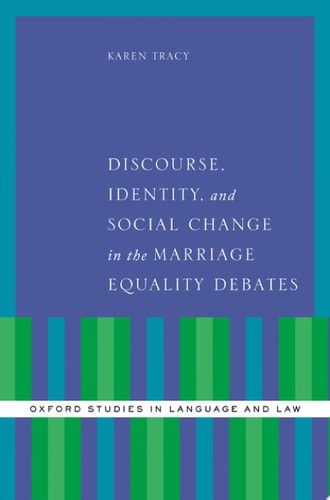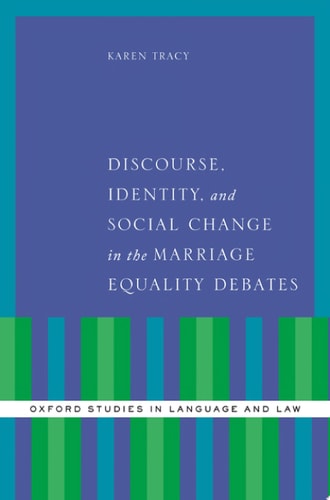
Discourse, Identity, and Social Change in the Marriage Equality Debates
0
0
As an Amazon Associate and affiliate partner, Menrva Books earns from qualifying purchases. Learn more
Author Description
Karen Tracy examines the identity-work of judges and attorneys in state supreme courts as they debated the legality of existing marriage laws. Exchanges in state appellate courts are juxtaposed with the talk that occurred between citizens and elected officials in legislative hearings considering whether to revise state marriage laws. The book's analysis spans ten years, beginning with the U.S. Supreme Court's overturning of sodomy laws in 2003 and ending in 2013 when the U.S. Supreme Court declared the federal government's Defense of Marriage Act (DOMA) unconstitutional, and it particularly focuses on how social change was accomplished through and reflected in these law-making and law-interpreting discourses. Focal materials are the eight cases about same-sex marriage and civil unions that were argued in state supreme courts between 2005 and 2009, and six of a larger number of hearings that occurred in state judicial committees considering bills regarding who should be able to marry. Tracy concludes with analysis of the 2011 Senate Judiciary Committee Hearing on DOMA, comparing it to the initial 1996 hearing and to the 2013 Supreme Court oral argument about it. The book shows that social change occurred as the public discourse that treated sexual orientation as a "lifestyle" was replaced with a public discourse of gays and lesbians as a legitimate category of citizen.
Menrva's Summary
THE THESIS
How does the evolution of public and legal discourse regarding same-sex marriage reflect and facilitate broader social change in the United States? Karen Tracy, a scholar in communication and language, utilizes a decade of transcripts from state supreme courts and legislative hearings to investigate the shift in how sexual orientation is framed in American law. By analyzing the linguistic choices of judges, attorneys, and legislators, she argues that the transition from viewing homosexuality as a 'lifestyle' to recognizing it as a protected category of citizenship was a critical component of the legal shift toward marriage equality.
THE SCOPE MAP
What You Will Find
- Analysis of eight state supreme court cases regarding same-sex marriage and civil unions between 2005 and 2009.
- Comparative study of legislative hearings, including the 1996 and 2011 Senate Judiciary Committee hearings on the Defense of Marriage Act.
- Linguistic framework focusing on identity-work and discourse analysis within legal and political settings.
Scope Limits
- The study does not cover international marriage equality movements or legal developments outside the United States.
- The analysis is restricted to formal legal and legislative discourse rather than grassroots activism or media coverage.
THE AUTHORITY PERSPECTIVE
Scholars in the fields of language and law frequently cite this work as a rigorous application of discourse analysis to high-stakes political debates. Readers often note the academic density of the prose, which is tailored for researchers and students interested in the intersection of rhetoric, identity, and judicial process.
Page Count:
224
Publication Date:
2016-05-13
Publisher:
Oxford University Press
ISBN-10:
0190217960
ISBN-13:
9780190217969
Interpretation and construction
Pleading
Gender Studies
English & College Success
Communication Studies
English
Judicial Power
Professional Career & Trade
Sociology
Law
Linguistics
Gay Studies
Marriage law