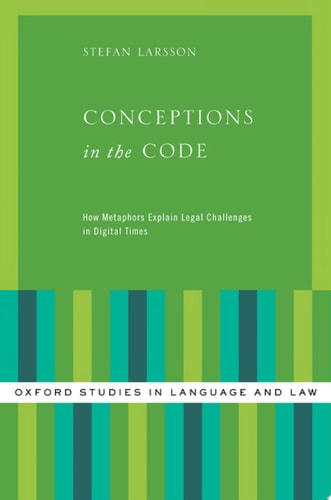
Conceptions in the Code: How Metaphors Explain Legal Challenges in Digital Times
0
0
As an Amazon Associate and affiliate partner, Menrva Books earns from qualifying purchases. Learn more
Author Description
Stefan Larsson's Conceptions in the Code makes a significant contribution to sociolegal analysis, representing a valuable contribution to conceptual metaphor theory. By utilising the case of copyright in a digital context it explains the role that metaphor plays when the law is dealing with technological change, displaying both conceptual path-dependence as well as what is called non-legislative developments in the law. The overall analysis draws from conceptual studies of "property" in intellectual property. By using Karl Renner's account of property, Larsson demonstrates how the property regime of copyright is the projection of an older regime of control onto a new set of digital social relations. Further, through an analysis of the concept of "copy" in copyright as well as the metaphorical battle of defining the BitTorrent site "The Pirate Bay" in the Swedish court case with its founders, Larsson shows the historical and embodied dependence of digital phenomena in law, and thereby how normative aspects of the source concept also stains the target domain. The book also draws from empirical studies on file sharing and historical expressions of the conceptualisation of law, revealing both the cultural bias of both file sharing and law. Also law is thereby shown to be largely depending on metaphors and embodiment to be reified and understood. The contribution is relevant for the conceptual and regulatory struggles of a multitude of contemporary socio-digital phenomena in addition to copyright and file sharing, including big data and the oft-praised "openness" of digital innovation.
Menrva's Summary
THE THESIS
How do metaphors shape the legal interpretation and regulation of digital technologies? Stefan Larsson, a researcher in law and sociology, investigates the role of conceptual metaphors in bridging the gap between established legal frameworks and emerging digital phenomena. By applying conceptual metaphor theory to intellectual property law, he argues that legal systems rely on historical, embodied concepts to interpret new technologies, often resulting in normative biases that influence regulatory outcomes.
THE SCOPE MAP
What You Will Find
- Analysis of the conceptualization of property within intellectual property law.
- Application of Karl Renner’s legal theory to digital social relations.
- Case study of the Swedish court proceedings regarding The Pirate Bay.
- Empirical data regarding file sharing and historical legal conceptualizations.
Scope Limits
- The text focuses primarily on copyright and file sharing as primary case studies.
- It does not provide a comprehensive guide to international digital law or specific legislative drafting techniques.
THE AUTHORITY PERSPECTIVE
Scholars in the field of law and technology recognize this work as a rigorous application of cognitive linguistics to sociolegal studies. Readers frequently note the academic density of the prose, which is intended for researchers and practitioners interested in the intersection of language, law, and digital innovation.
Page Count:
268
Publication Date:
2017-01-01
Publisher:
Oxford University Press
ISBN-10:
0190650400
ISBN-13:
9780190650407
English
Linguistics
Professional Career & Trade
English & College Success
Sociology
Computer Networks
Technology and Society
Law
Intellectual Property
Community Tags
Similar Books