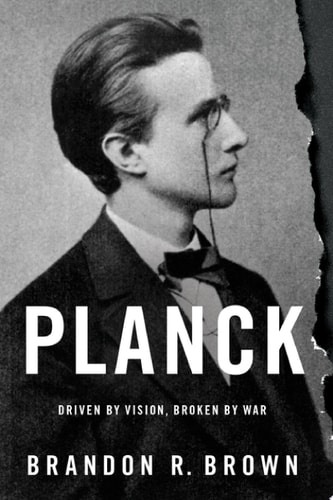
Planck: Driven by Vision, Broken by War
0
0
As an Amazon Associate and affiliate partner, Menrva Books earns from qualifying purchases. Learn more
Author Description
Max Planck is credited with being the father of quantum theory, and his work was described by his close friend Albert Einstein as "the basis of all twentieth-century physics." But Planck's story is not well known, especially in the United States. A German physicist working during the first half of the twentieth century, his library, personal journals, notebooks, and letters were all destroyed with his home in World War II. What remains, other than his contributions to science, are handwritten letters in German shorthand, and tributes from other scientists of the time. In Planck: Driven by Vision, Broken by War, Brandon R. Brown interweaves the voices and writings of Planck, his family, and his contemporaries--with many passages appearing in English for the first time--to create a portrait of a groundbreaking physicist working in the midst of war. Planck spent much of his adult life grappling with the identity crisis of being an influential German with ideas that ran counter to his government. During the later part of his life, he survived bombings and battlefields, surgeries and blood transfusions, all the while performing his influential work amidst a violent and crumbling Nazi bureaucracy. When his son was accused of treason, Planck tried to use his standing as a German "national treasure," and wrote directly to Hitler to spare his son's life. Brown tells the story of Planck's friendship with the far more outspoken Albert Einstein, and shows how his work fits within the explosion of technology and science that occurred during his life. This story of a brilliant man living in a dangerous time gives Max Planck his rightful place in the history of science, and it shows how war-torn Germany deeply impacted his life and work.
Menrva's Summary
THE THESIS
How did the life and scientific contributions of Max Planck persist despite the catastrophic pressures of the Nazi regime and the destruction of his personal archives during World War II? Author Brandon R. Brown utilizes a synthesis of surviving correspondence, contemporary tributes, and historical context to reconstruct the life of the physicist who established the foundation of quantum theory. The narrative examines the tension between Planck's status as a German national treasure and his personal struggle to maintain scientific integrity while navigating a crumbling, hostile political environment.
THE SCOPE MAP
What You Will Find
- Biographical analysis of Max Planck's professional and personal life in early 20th-century Germany.
- Examination of the development of quantum theory and its impact on modern physics.
- Primary source material including translated letters and journals from Planck and his contemporaries.
- Contextual history of the scientific community under the Nazi bureaucracy.
Scope Limits
- The book does not provide a comprehensive technical textbook on quantum mechanics.
- The narrative is limited by the destruction of many of Planck's original personal documents during wartime bombings.
THE AUTHORITY PERSPECTIVE
Experts and readers frequently note the accessibility of this biography, which successfully balances complex scientific history with a humanizing account of the subject's personal tragedies. It is widely regarded as a significant contribution to the history of science for its use of previously untranslated primary sources.
Page Count:
258
Publication Date:
2015-01-01
Publisher:
Oxford University Press
ISBN-10:
0190219491
ISBN-13:
9780190219499
Biography
Non-Fiction
Science
History
Physics
Physicists biography
Earth Sciences
World War
Community Tags
Similar Books