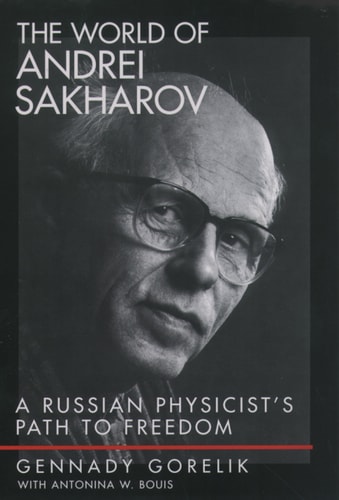
The World of Andrei Sakharov: A Russian Physicist's Path to Freedom
0
0
As an Amazon Associate and affiliate partner, Menrva Books earns from qualifying purchases. Learn more
Author Description
How did Andrei Sakharov, a theoretical physicist and the acknowledged father of the Soviet hydrogen bomb, become a human rights activist and the first Russian to win the Nobel Peace Prize? In his later years, Sakharov noted in his diary that he was "simply a man with an unusual fate." To understand this deceptively straightforward statement by an extraordinary man, The World of Andrei Sakharov, the first authoritative study of Andrei Sakharov as a scientist as well as a public figure, relies on previously inaccessible documents, recently declassified archives, and personal accounts by Sakharov's friends and colleagues to examine the real context of Sakharov's life. In the course of doing so, Gennady Gorelik answers a fascinating question, whether the Soviet hydrogen bomb was really fathered by Sakharov, or whether it was based on stolen American secrets. Gorelik concludes that while espionage did initiate the Soviet effort, the Russian hydrogen bomb was invented independently. Gorelik also elucidates the reasons that brought about the seemingly sudden transformation of the top-secret physicist into a public figure in 1968, when Sakharov's famous essay "Progress, Peaceful Coexistence, and Intellectual Freedom" was distributed in samizdat in the USSR and smuggled out to the West. Recently declassified documents show that Sakharov's metamorphosis was caused by professional concerns, particularly regarding the development of an anti-ballistic missile defense. An insider's view of how the upper echelons of the Soviet regime functioned had led Sakharov to the conclusion that the goals of peace, progress, and human rights were inextricably linked. His free thinking and free feeling were manifested in his hope that scientific thought and religious perception would find a profound synthesis in the future.
Menrva's Summary
THE THESIS
This work investigates the transformation of Andrei Sakharov from a primary architect of the Soviet hydrogen bomb into a prominent human rights activist and Nobel laureate. Gennady Gorelik, utilizing his background in the history of science, synthesizes recently declassified Soviet archives, personal correspondence, and interviews with Sakharov's contemporaries. The text argues that Sakharov's shift toward dissent was rooted in his professional expertise and his intimate understanding of the Soviet regime's internal mechanics, rather than a sudden ideological departure.
THE SCOPE MAP
What You Will Find
- Analysis of the development of the Soviet hydrogen bomb and the role of espionage versus independent innovation.
- Examination of the 1968 essay "Progress, Peaceful Coexistence, and Intellectual Freedom" and its impact on Soviet society.
- Detailed accounts of Sakharov's professional concerns regarding anti-ballistic missile defense systems.
Scope Limits
- The text does not provide a comprehensive biography of Sakharov's early childhood or personal life outside of his scientific and political career.
THE AUTHORITY PERSPECTIVE
Experts recognize this study as a foundational text for understanding the intersection of Cold War nuclear physics and Soviet political dissent. Readers frequently note the meticulous use of archival evidence to clarify long-standing debates regarding Sakharov's scientific contributions.
Page Count:
424
Publication Date:
2005-01-01
Publisher:
Oxford University Press
ISBN-10:
0190288779
ISBN-13:
9780190288778
History
Biography
Science
Human rights
European History
Physics
Soviet History
Earth Sciences
Physicists biography
Community Tags
Similar Books