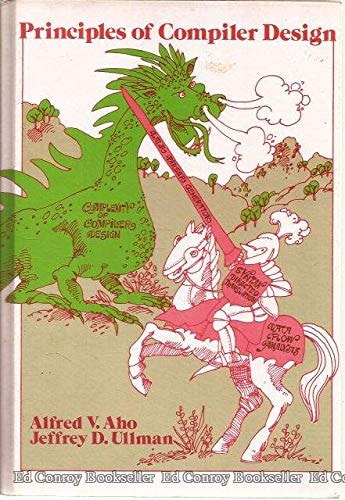
Principles of Compiler Design
0
0
As an Amazon Associate and affiliate partner, Menrva Books earns from qualifying purchases. Learn more
Author Description
Principles of Compiler Design is a classic textbook that covers the fundamental concepts of compiler design. It provides a comprehensive introduction to the theory and practice of building compilers, including lexical analysis, parsing, semantic analysis, and code generation.
Menrva's Summary
THE THESIS
This text investigates the fundamental principles and mathematical frameworks required to construct efficient compilers for high-level programming languages. Alfred V. Aho and Jeffrey D. Ullman, both distinguished researchers in computer science, synthesize decades of theoretical work to provide a rigorous approach to language translation. The book establishes a systematic methodology for transforming source code into machine-executable instructions while maintaining logical integrity and performance optimization.
THE SCOPE MAP
What You Will Find
- Lexical analysis and tokenization techniques
- Syntax analysis using context-free grammars and parsing algorithms
- Intermediate code generation and symbol table management
- Code optimization strategies and target machine code generation
THE AUTHORITY PERSPECTIVE
Experts widely recognize this work as a foundational text in the field of compiler construction, often cited for its mathematical depth and clarity. Readers frequently note the academic density of the prose, which requires a strong background in formal language theory to fully comprehend the presented algorithms.
Page Count:
614
Publication Date:
1977-01-01
Publisher:
Addison-Wesley
ISBN-10:
0201000229
ISBN-13:
9780201000221
Computer programs
Programming
Computer Science
Software Engineering
textbook
Community Tags
Similar Books