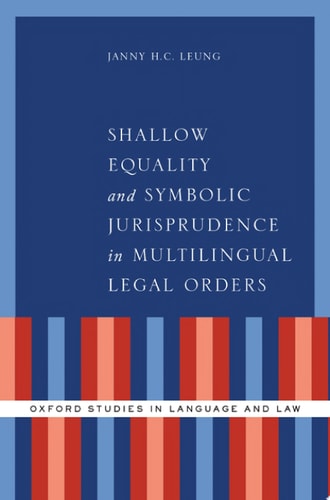
Shallow Equality and Symbolic Jurisprudence in Multilingual Legal Orders
0
0
As an Amazon Associate and affiliate partner, Menrva Books earns from qualifying purchases. Learn more
Author Description
What Challenges Face Jurisdictions That Attempt To Conduct Law In Two Or More Languages? How Does Choosing A Legal Language Affect The Way In Which Justice Is Delivered? Answers To These Questions Are Vital For The 75 Officially Bilingual And Multilingual States Of The World, As Well As For Other States Contemplating A Move Towards Multilingualism. Arguably Such Questions Have Implications For All Countries In A World Characterized By The Pressures Of Globalization, Economic Integration, Population Mobility, Decolonization, And Linguistic Re-colonization. For Lawyers, Addressing Such Challenges Is Made Essential By The Increased Frequency And Scale Of Transnational Legal Dealings And Proceedings, As Well As By The Lengthening Reach Of International Law. But It Is Not Only Policy Makers, Legislators, And Other Legal Practitioners Who Must Think About Such Questions. The Relationship Between Societal Multilingualism And Law Also Raises Questions For The Burgeoning Field Of Language And Law, Which Posits--among Other Tenets--the Centrality Of Language In Legal Processes. In This Book, Janny H.c. Leung Examines Key Aspects Of Legal Multilingualism. Drawing Extensively On Case Studies, She Describes The Implications Of The Legal, Practical, And Ideological Dilemmas Encountered In A Given Country When It Becomes Bilingual Or Multilingual, Discussing Such Issues As: How Legal Certainty And The Linguistic Ideology Of Authenticity May Be Challenged In A Multilingual Jurisdiction; How Courts Balance The Language Preferences Of Different Courtroom Participants; And What Historical, Socio-political And Economic Factors May Influence The Decision To Cement A Given Language As A Jurisdiction's Official Language. Throughout, Leung Elaborates A Theory Of Symbolic Jurisprudence To Explore Common Dilemmas Found Across Countries, Despite Their Varied Political And Cultural Settings, And Argues That Linguistic Equality As Proclaimed And Practiced Today Is A Shallow Kind Of Equality.
Menrva's Summary
THE THESIS
This book investigates the core question of how multilingual legal orders navigate the tension between linguistic equality and the practical realities of justice delivery. Janny H.C. Leung, an expert in the intersection of language and law, utilizes a comparative framework to analyze how states manage the complexities of official bilingualism and multilingualism. She argues that current practices often result in a superficial form of equality, which she defines through her developed theory of symbolic jurisprudence.
THE SCOPE MAP
What You Will Find
- Comparative analysis of 75 officially bilingual and multilingual states
- Theoretical framework of symbolic jurisprudence
- Examination of legal certainty and linguistic ideology
- Case studies on courtroom language preferences and official language selection
Scope Limits
- Does not provide a universal manual for legislative drafting
- Does not cover every specific regional dialect or minor legal system
THE AUTHORITY PERSPECTIVE
Experts in the field of language and law recognize this work as a significant contribution to understanding the ideological dilemmas inherent in multilingual jurisdictions. Readers frequently note the academic density of the prose, which serves as a foundational text for scholars and policy makers examining the relationship between societal multilingualism and legal practice.
Page Count:
272
Publication Date:
2019-01-01
Publisher:
Oxford University Press
ISBN-10:
0190210346
ISBN-13:
9780190210342
Jurisprudence
Linguistics
International Law
Law
Community Tags
Similar Books