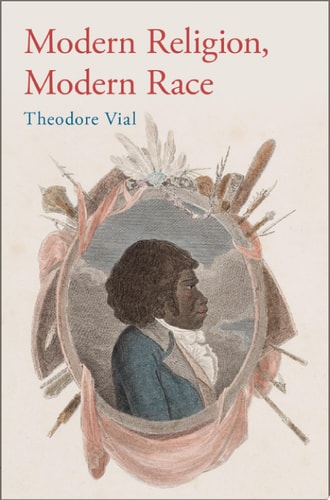
Modern Religion, Modern Race
0
0
As an Amazon Associate and affiliate partner, Menrva Books earns from qualifying purchases. Learn more
Author Description
Religion is a racialized category, even when race is not explicitly mentioned. In Modern Religion, Modern Race Theodore Vial argues that because the categories of religion and race are rooted in the post-Enlightenment project of reimagining what it means to be human, we cannot simply will ourselves to stop using them. Only by acknowledging that religion is already racialized can we begin to understand how the two concepts are intertwined and how they operate in our modern world.It has become common to argue that the category religion is not universal, or even very old, but is a product of Europe's Enlightenment modernization. Equally common is the argument that religion is not an innocent category of analysis, but is implicated in colonial regimes of control and as such plays a role in Europe's process of identity construction of itself and of non-European "others." Current debates about race follow an eerily similar trajectory: race is not an ancient but a modern construction. It is part of the project of colonialism, and race discourse forms one of the cornerstones of modern European identity-making. Why can't we stop using them, or re-construct them in less toxic ways? By examining the theories of Kant, Herder, and Schleiermacher, among others, Vial uncovers co-constitutive nature of race and religion, describes how they became building blocks of the modern world, and shows how the two concepts continue to be used today to form identity and to make sense of the world. He shows that while we disdain the racist language of some of the founders of religious studies, the continued influence of the modern worldview they helped create leads us, often unwittingly, to reiterate many of the same distinctions and hierarchies.Although it may not be time to abandon the very category of religion, with all its attendant baggage, Modern Religion, Modern Race calls for us to examine that baggage critically, and to be fully conscious of the ways in which religion always carries w
Menrva's Summary
THE THESIS
How do the modern categories of religion and race function as co-constitutive elements of the post-Enlightenment project of defining humanity? Theodore M. Vial, a scholar of religion, utilizes historical analysis and philosophical critique to argue that these concepts are not neutral analytical tools but are deeply implicated in colonial regimes and European identity formation. By examining the works of thinkers such as Kant, Herder, and Schleiermacher, Vial demonstrates that the modern worldview inherently relies on these racialized frameworks, making them difficult to abandon or reconstruct without conscious critical engagement.
THE SCOPE MAP
What You Will Find
- Historical analysis of Enlightenment-era philosophy and its impact on modern categorization.
- Critical examination of the works of Immanuel Kant, Johann Gottfried von Herder, and Friedrich Schleiermacher.
- Theoretical framework regarding the co-constitutive nature of race and religion in colonial and post-colonial contexts.
- Investigation into how religious studies as a discipline continues to mirror historical hierarchies.
Scope Limits
- The text does not provide a comprehensive history of all world religions, focusing instead on the Western construction of the category of religion.
- It does not offer a definitive manual for the complete abandonment of the term religion, but rather advocates for critical awareness of its usage.
THE AUTHORITY PERSPECTIVE
Scholars in the fields of religious studies and critical race theory frequently identify this work as a significant contribution to understanding the genealogy of modern identity categories. Readers often note the academic density of the prose, which requires a foundational familiarity with Enlightenment philosophy to fully grasp the author's arguments.
Page Count:
296
Publication Date:
2016-07-15
Publisher:
Oxford University Press
ISBN-10:
0190212551
ISBN-13:
9780190212551
Religion
Philosophy
Sociology
Race Relations
Race Studies
Philosophy & Religion
History of Ideas