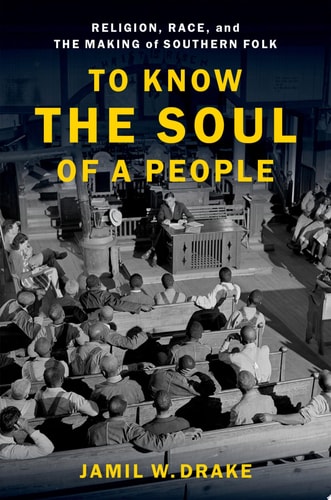
To Know the Soul of a People: Religion, Race, and the Making of Southern Folk
0
0
As an Amazon Associate and affiliate partner, Menrva Books earns from qualifying purchases. Learn more
Author Description
To Know the Soul of a People is a history of religion and race in the agricultural South before the Civil Rights era. Jamil W. Drake chronicles a cadre of social scientists who studied the living conditions of black rural communities, revealing the abject poverty of the Jim Crow south. These university-affiliated social scientists documented shotgun houses, unsanitary privies and contaminated water, scaly hands, enlarged stomachs, and malnourished bodies. However, they also turned their attention to the spiritual possessions, chanted sermons, ecstatic singing, conjuration, dreams and visions, fortune-telling, taboos, and other religious cultures of these communities. These scholars aimed to illuminate the impoverished conditions of their subjects for philanthropic and governmental organizations, as well as the broader American public, in the first half of the 20th century, especially during the Great Depression. Religion was integral to their efforts to chart the long economic depression across the South.From 1924 to 1941, Charles Johnson, Guy Johnson, Allison Davis, Lewis Jones, and other social scientists framed the religious and cultural practices of the black communities as “folk” practices, aiming to reform them and the broader South. Drawing on their correspondence, fieldnotes, and monographs, Drake shows that social scientists' use of “folk” reveals the religion was an important site for highlighting the supposed mental, moral, and cultural deficits of America's so-called folk population. Moreover, these social scientists did not just pioneer rural social science and reform but used their study of religion to plant the seeds of the concept that would become known as the “culture of poverty” in the latter half of the twentieth century. To Know the Soul of a People is an exciting intellectual history that invites us to explore the knowledge that animated the earnest yet shortsighted liberal efforts to reform black and impoverished communities.
Menrva's Summary
THE THESIS
How did early twentieth-century social scientists utilize the study of religion to construct and perpetuate the concept of a 'folk' population in the American South? Jamil W. Drake, a scholar of American religion, examines the intersection of academic inquiry, philanthropy, and racial politics during the pre-Civil Rights era. By analyzing the work of researchers like Charles Johnson and Allison Davis, Drake argues that these scholars framed black religious practices as cultural deficits, inadvertently laying the groundwork for the later 'culture of poverty' discourse.
THE SCOPE MAP
What You Will Find
- Analysis of social science research conducted between 1924 and 1941.
- Examination of the transition from rural sociology to the 'culture of poverty' framework.
- Investigation into the intersection of religious studies and economic reform efforts.
Scope Limits
- The study focuses primarily on the academic and philanthropic perspectives of the researchers rather than the internal theological developments of the communities themselves.
- The analysis is bounded by the period from 1924 to 1941, excluding post-Civil Rights era developments.
THE AUTHORITY PERSPECTIVE
Scholars in the fields of American religious history and sociology recognize this text as a critical intervention in understanding how academic frameworks shaped public policy toward marginalized communities. Readers frequently note the rigorous use of archival correspondence and field notes to expose the biases inherent in early twentieth-century social science.
Page Count:
287
Publication Date:
2021-01-01
Publisher:
Oxford University Press
ISBN-10:
0190082712
ISBN-13:
9780190082710
Religion
History
Ethnic Studies
United States
African Americans
Race Relations
Minority Studies
African American
Ethnology
History of the Americas
Southern Studies
Sociology
Intellectual History
Folk religion
Sociology - History
Community Tags
Similar Books