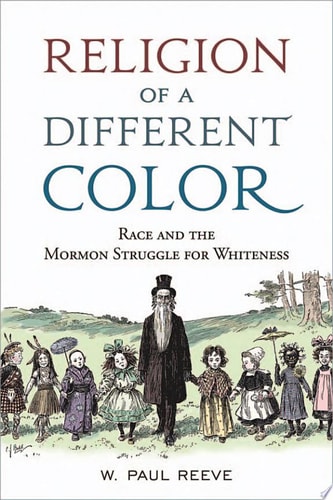
Religion of a Different Color: Race and the Mormon Struggle for Whiteness
0
0
As an Amazon Associate and affiliate partner, Menrva Books earns from qualifying purchases. Learn more
Author Description
Mormonism is one of the few homegrown religions in the United States, one that emerged out of the religious fervor of the early nineteenth century. Yet, members of the Church of Jesus Christ of Latter-day Saints have struggled for status and recognition. In this book, W. Paul Reeve explores the ways in which nineteenth century Protestant white America made outsiders out of an inside religious group. Much of what has been written on Mormon otherness centers upon economic, cultural, doctrinal, marital, and political differences that set Mormons apart from mainstream America. Reeve instead looks at how Protestants racialized Mormons, using physical differences in order to define Mormons as non-White to help justify their expulsion from Ohio, Missouri, and Illinois. He analyzes and contextualizes the rhetoric on Mormons as a race with period discussions of the Native American, African American, Oriental, Turk/Islam, and European immigrant races. He also examines how Mormon male, female, and child bodies were characterized in these racialized debates. For instance, while Mormons argued that polygamy was ordained by God, and so created angelic, celestial, and elevated offspring, their opponents suggested that the children were degenerate and deformed.The Protestant white majority was convinced that Mormonism represented a racial-not merely religious-departure from the mainstream and spent considerable effort attempting to deny Mormon whiteness. Being white brought access to political, social, and economic power, all aspects of citizenship in which outsiders sought to limit or prevent Mormon participation. At least a part of those efforts came through persistent attacks on the collective Mormon body, ways in which outsiders suggested that Mormons were physically different, racially more similar to marginalized groups than they were white. Medical doctors went so far as to suggest that Mormon polygamy was spawning a new race. Mormons responded with aspirations toward whiten
Menrva's Summary
THE THESIS
This book investigates how nineteenth-century Protestant Americans utilized racialization to marginalize the Church of Jesus Christ of Latter-day Saints and deny its members status as white citizens. W. Paul Reeve, a professor of history, utilizes extensive archival research and period rhetoric to demonstrate that Mormon "otherness" was constructed through physical and racial characterizations rather than solely religious or doctrinal disagreements. He argues that by framing Mormons as a distinct, non-white race, opponents sought to justify systemic exclusion and limit their access to the political and social benefits of whiteness.
THE SCOPE MAP
What You Will Find
- Analysis of nineteenth-century American racial discourse regarding Native Americans, African Americans, and European immigrants.
- Examination of how medical and political rhetoric characterized the physical bodies of Mormon men, women, and children.
- Historical documentation of the expulsion of Mormons from Ohio, Missouri, and Illinois.
- Discussion of the Mormon response to these racialized attacks and their subsequent efforts to claim whiteness.
Scope Limits
- The study focuses primarily on the nineteenth-century period and does not provide a comprehensive history of twentieth-century Mormon racial policies.
- The text does not offer a theological defense or critique of Mormon doctrine, focusing instead on the sociological and political construction of race.
THE AUTHORITY PERSPECTIVE
Scholars and historians frequently cite this work as a significant contribution to the understanding of how religious identity and racial categories intersected in American history. Readers often note the academic rigor of the research and the clarity with which the author connects historical rhetoric to broader themes of citizenship and social power.
Page Count:
351
Publication Date:
2015-01-01
Publisher:
Oxford University Press
ISBN-10:
0190226277
ISBN-13:
9780190226275
Religion
History
Sociology
Mormon Studies
Mormons
Special Topics
Race Studies
American History
Race Relations
Whites
Ethnic Studies
Community Tags
Similar Books