Making the Bible Belt: Texas Prohibitionists and the Politicization of Southern Religion
0
0
As an Amazon Associate and affiliate partner, Menrva Books earns from qualifying purchases. Learn more
Author Description
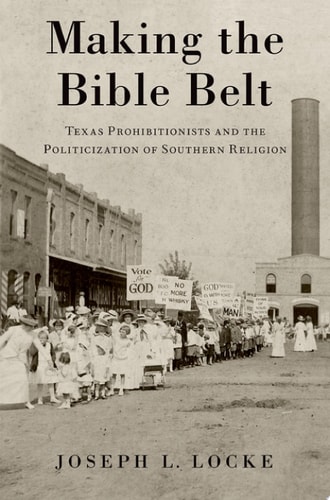
Making the Bible Belt upends notions of a longstanding, stable marriage between political religion and the American South. H.L. Mencken coined the term "the Bible Belt" in the 1920s to capture the peculiar alliance of religion and public life in the South, but the reality he described was only the closing chapter of a long historical process. Into the twentieth century, a robust anticlerical tradition still challenged religious forays into southern politics. Inside southern churches, an insular evangelical theology looked suspiciously on political meddling. Outside of the churches, a popular anticlericalism indicted activist ministers with breaching the boundaries of their proper spheres of influence, calling up historical memories of the Dark Ages and Puritan witch hunts. Through the politics of prohibition, and in the face of bitter resistance, a complex but shared commitment to expanding the power and scope of religion transformed southern evangelicals' inward-looking restraints into an aggressive, self-assertive, and unapologetic political activism. The decades-long religious crusade to close saloons and outlaw alcohol in the South absorbed the energies of southern churches and thrust religious leaders headlong into the political process--even as their forays into southern politics were challenged at every step. Early defeats impelled prohibitionist clergy to recast their campaign as a broader effort not merely to dry up the South, but to conquer anticlerical opposition and inject religion into public life. Clerical activists churned notions of history, race, gender, and religion into a powerful political movement and elevated ambitious leaders such as the pugnacious fundamentalist J. Frank Norris and Senator Morris Sheppard, the "Father of National Prohibition." Exploring the controversies surrounding the religious support of prohibition in Texas, Making the Bible Belt reconstructs the purposeful, decades-long campaign to politicize southern religion.
Menrva's Summary
THE THESIS
This book investigates the historical process by which Texas prohibitionists transformed southern religion from an inward-looking evangelical tradition into an aggressive, politicized force. Joseph L. Locke, a historian of the American South, utilizes archival records and primary source materials to argue that the 'Bible Belt' was not a static cultural feature but a constructed political reality. He demonstrates how the decades-long crusade against alcohol served as the primary vehicle for religious leaders to overcome anticlerical resistance and integrate evangelical theology into the machinery of public governance.
THE SCOPE MAP
What You Will Find
- Analysis of the political strategies employed by Texas prohibitionists to influence public policy.
- Examination of the tension between evangelical theology and anticlerical traditions in the early 20th century.
- Profiles of influential figures such as J. Frank Norris and Senator Morris Sheppard.
Scope Limits
- The study focuses primarily on the Texas experience rather than a comprehensive national history of the prohibition movement.
- The analysis does not cover the post-repeal legacy of these political structures in detail.
THE AUTHORITY PERSPECTIVE
Historians and scholars of American religion frequently cite this work for its nuanced challenge to the assumption that southern political religion is an ancient or inevitable phenomenon. Experts highlight the text as a significant contribution to understanding the intersection of race, gender, and clerical activism in the early twentieth-century South.
Page Count:
295
Publication Date:
2017-01-01
Publisher:
Oxford University Press
ISBN-10:
0190216301
ISBN-13:
9780190216306
Religion
Politics
History
Prohibition
Texas history
American History
Social Life
Community Tags
Similar Books