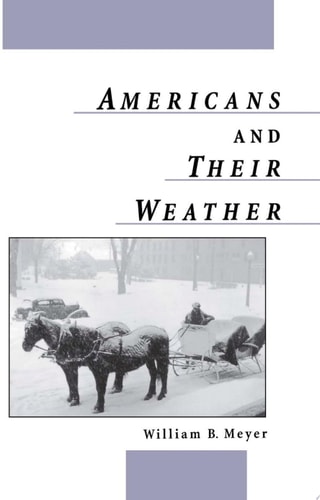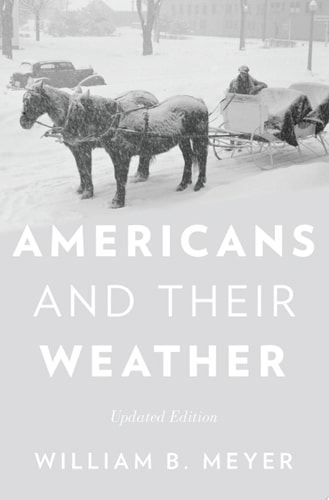
Americans and Their Weather: Updated Edition
0
0
As an Amazon Associate and affiliate partner, Menrva Books earns from qualifying purchases. Learn more
Author Description
This revealing book synthesizes research from many fields to offer the first complete history of the roles played by weather and climate in American life from colonial times to the present. Author William B. Meyer characterizes weather events as neutral phenomena that are inherently neither hazards nor resources, but can become either depending on the activities with which they interact. Meyer documents the ways in which different kinds of weather throughout history have represented hazards and resources not only for such exposed outdoor pursuits as agriculture, warfare, transportation, construction, and recreation, but for other realms of life ranging from manufacturing to migration to human health. He points out that while the weather and climate by themselves have never determined the course of human events, their significance as been continuously altered for better and for worse by the evolution of American life.
Menrva's Summary
THE THESIS
This book investigates how weather and climate have functioned as both hazards and resources throughout the history of American life from the colonial era to the present. William B. Meyer, a scholar of geography and environmental history, synthesizes interdisciplinary research to argue that weather events are neutral phenomena whose impact is defined by human activity. He posits that while climate does not dictate human events, the significance of meteorological conditions has evolved alongside American technological and social development.
THE SCOPE MAP
What You Will Find
- A comprehensive historical analysis of weather's impact on agriculture, warfare, and transportation.
- An examination of how manufacturing, migration, and public health have been shaped by climatic conditions.
- A conceptual framework for understanding weather as a variable resource rather than a static environmental force.
Scope Limits
- The text does not provide a predictive model for future climate change scenarios.
- It does not focus on localized meteorological data, but rather on broad societal interactions with climate.
THE AUTHORITY PERSPECTIVE
Experts recognize this work as a foundational text for understanding the intersection of environmental history and human geography. Readers frequently note the academic density of the prose and the breadth of the historical synthesis provided.
Page Count:
312
Publication Date:
2014-01-01
Publisher:
Oxford University Press
ISBN-10:
0190212829
ISBN-13:
9780190212827
History
Religion
Social Science
Weather
Geology
Mineralogy
Climatology
American History
Earth Sciences
Environmental History
Community Tags
Similar Books