Earth's Deep History
0
0
As an Amazon Associate and affiliate partner, Menrva Books earns from qualifying purchases. Learn more
Author Description
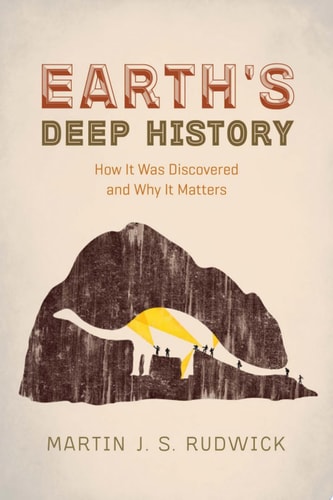
Earth has been witness to mammoths and dinosaurs, global ice ages, continents colliding or splitting apart, and comets and asteroids crashing catastrophically to the surface, as well as the birth of humans who are curious to understand it. But how was all this discovered? How was the evidence for it collected and interpreted? And what kinds of people have sought to reconstruct this past that no human witnessed or recorded? In this sweeping and accessible book, Martin J. S. Rudwick, the premier historian of the Earth sciences, tells the gripping human story of the gradual realization that the Earth’s history has not only been unimaginably long but also astonishingly eventful. Rudwick begins in the seventeenth century with Archbishop James Ussher, who famously dated the creation of the cosmos to 4004 BC. His narrative later turns to the crucial period of the late eighteenth and early nineteenth centuries, when inquisitive intellectuals, who came to call themselves “geologists,” began to interpret rocks and fossils, mountains and volcanoes, as natural archives of Earth’s history. He then shows how this geological evidence was used—and is still being used—to reconstruct a history of the Earth that is as varied and unpredictable as human history itself. Along the way, Rudwick rejects the popular view of this story as a conflict between science and religion and shows how the modern scientific account of the Earth’s deep history retains strong roots in Judaeo-Christian ideas. Extensively illustrated, Earth’s Deep History is an engaging and impressive capstone to Rudwick’s distinguished career. Though the story of the Earth is inconceivable in length, Rudwick moves with grace from the earliest imaginings of our planet’s deep past to today’s scientific discoveries, proving that this is a tale at once timeless and timely.
Menrva's Summary
THE THESIS
This book investigates how humanity gradually came to understand the immense age and eventful nature of Earth's history, tracing the human story behind the scientific discoveries. Martin J. S. Rudwick, a leading historian of Earth sciences, details the process by which evidence from rocks, fossils, and geological formations was collected and interpreted to reconstruct a past that predates human observation. The narrative begins with early attempts to date creation and progresses through the pivotal era of the late 18th and early 19th centuries when geology emerged as a discipline. Rudwick emphasizes that this scientific endeavor has deep roots in Judaeo-Christian thought, challenging the notion of a conflict between science and religion.
THE SCOPE MAP
- The historical development of geological interpretation from the 17th century to contemporary discoveries.
- Key figures and intellectual movements in the history of Earth sciences, including Archbishop James Ussher and early geologists.
- Analysis of how natural archives like rocks and fossils were used to reconstruct Earth's deep past.
- Exploration of the relationship between scientific understanding of Earth's history and religious ideas.
THE AUTHORITY PERSPECTIVE
This work is recognized as a significant contribution by a premier historian of Earth sciences, offering a sweeping and accessible narrative of discovery. It is lauded for its engaging portrayal of the human story behind understanding our planet's deep history. The book is noted for its extensive illustrations and its nuanced perspective on the interplay between scientific inquiry and religious thought. Rudwick's capstone achievement is seen as a timely and timeless account of Earth's evolution.
Page Count:
372
Publication Date:
2014-10-15
Publisher:
University of Chicago Press
ISBN-10:
022620409X
ISBN-13:
9780226204093
Non-Fiction
History
Science
Biography
Religion
Intellectual History
Geology
Community Tags
Similar Books