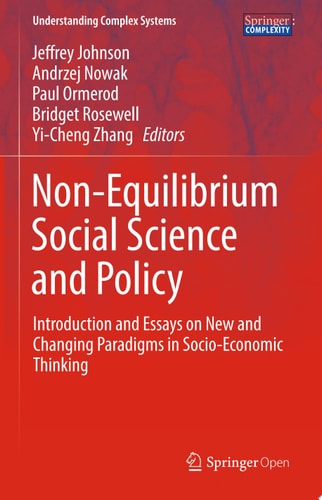
Non-Equilibrium Social Science and Policy: Introduction and Essays on New and Changing Paradigms in Socio-Economic Thinking
0
0
As an Amazon Associate and affiliate partner, Menrva Books earns from qualifying purchases. Learn more
Author Description
The overall aim of this book, an outcome of the European FP7 FET Open NESS project, is to contribute to the ongoing effort to put the quantitative social sciences on a proper footing for the 21st century. A key focus is economics, and its implications on policy making, where the still dominant traditional approach increasingly struggles to capture the economic realities we observe in the world today - with vested interests getting too often in the way of real advances.Insights into behavioral economics and modern computing techniques have made possible both the integration of larger information sets and the exploration of disequilibrium behavior. The domain-based chapters of this work illustrate how economic theory is the only branch of social sciences which still holds to its old paradigm of an equilibrium science - an assumption that has already been relaxed in all related fields of research in the light of recent advances in complex and dynamical systems theory and related data mining.The other chapters give various takes on policy and decision making in this context. Written in nontechnical style throughout, with a mix of tutorial and essay-like contributions, this book will benefit all researchers, scientists, professionals and practitioners interested in learning about the 'thinking in complexity' to understand how socio-economic systems really work.
Menrva's Summary
THE THESIS
This book challenges the traditional equilibrium-based paradigm in economics, arguing for a more dynamic, quantitative approach to understanding socio-economic systems. The authors, drawing from the European FP7 FET Open NESS project, aim to establish a robust quantitative social science for the 21st century, with a particular focus on economics and its policy implications. They highlight how traditional economic models struggle to reflect current realities, often hindered by vested interests, and propose integrating insights from behavioral economics and modern computing to analyze disequilibrium behavior. The work contrasts economics' adherence to old paradigms with advances in complex and dynamical systems theory seen in other social sciences.
THE SCOPE MAP
- Integration of larger information sets and exploration of disequilibrium behavior through behavioral economics and modern computing techniques.
- Analysis of economics as the only social science still adhering to an equilibrium paradigm, contrasting it with complex and dynamical systems theory.
- Illustrations of how economic theory can be updated to reflect observed economic realities.
- Discussions on policy and decision-making within the context of non-equilibrium socio-economic systems.
- Contributions written in a non-technical style, suitable for researchers, scientists, professionals, and practitioners.
- Exploration of 'thinking in complexity' to understand the workings of socio-economic systems.
THE AUTHORITY PERSPECTIVE
The book is presented as a contribution to the ongoing effort to modernize quantitative social sciences, particularly economics, by moving beyond traditional equilibrium models. It aims to provide insights into how socio-economic systems function in reality, incorporating advances in behavioral economics and computational techniques. The work is intended for a broad audience of researchers and practitioners interested in complexity and dynamic systems, offering a non-technical approach to these advanced topics. The framing suggests a focus on theoretical advancements and their practical implications for policy.
Page Count:
232
Publication Date:
2017-01-01
Publisher:
Springer Open
ISBN-10:
3319424246
ISBN-13:
9783319424248
Economics
Non-Fiction
Science
Science & Technology
Complexity Theory
Policy Making
Social Science
Community Tags
Similar Books