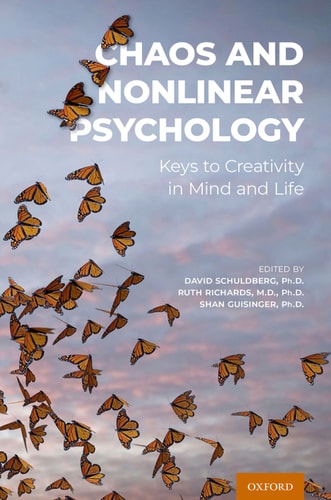
Chaos and Nonlinear Psychology: Keys to Creativity in Mind and Life
0
0
As an Amazon Associate and affiliate partner, Menrva Books earns from qualifying purchases. Learn more
Author Description
The pandemic, and our response to it, have shown how unpredictable, irrational, illogical, suddenly changing, and muddled human interactions can be in a time of crisis. How can we make sense of such confusing and baffling behavior? This book reveals how chaos and nonlinear dynamics can bring new understanding to everyday topics in social sciences. It brings together chapters from leaders at the intersection of psychology and chaos and complexity theories. Conceptual and user-friendly, it is built around six themes: 1) Seeing nonlinearity, 2) Finding patterns, 3) using Simple models, 4) Intervening nonlinearly, and 6) teaching a new Worldview. It takes no specialized study-although there is more sophisticated material and optional math for those wishing it. The techie will, in addition, find concepts and diagrams to ponder. The volume is engaging, at times startling-whether about the weather, Internet, organizations, family dynamics, health, evolution, or falling in love. It reveals how many social, personal, clinical, research, and life phenomena become understandable and can be modelled in the light of Nonlinear Dynamical Systems (NDS) theory. It even offers a broadening worldview, happening already in other sciences, toward a more dynamic, interconnected, and evolving picture, including process-oriented appreciation of one's own experience. The book offers those in the field of psychology and the social sciences a stunning new perspective on human behaviour.
Menrva's Summary
THE THESIS
This book investigates how chaos and nonlinear dynamical systems theory can provide a framework for understanding unpredictable human behavior and complex social interactions. The authors, representing leaders at the intersection of psychology and complexity science, argue that traditional linear models are insufficient for capturing the nuances of human experience. By applying concepts from nonlinear dynamics, they provide a structured approach to modeling phenomena ranging from family dynamics to organizational behavior and personal evolution.
THE SCOPE MAP
What You Will Find
- A six-theme framework covering nonlinearity, pattern recognition, and simple modeling.
- Applications of Nonlinear Dynamical Systems (NDS) theory to social, clinical, and research contexts.
- Optional mathematical models and diagrams for readers seeking technical depth.
Scope Limits
- The text does not provide a comprehensive history of chaos theory outside of its psychological and social applications.
- It does not offer a clinical manual for treating specific psychiatric disorders.
THE AUTHORITY PERSPECTIVE
Experts identify this volume as a bridge between abstract mathematical theory and practical application in the social sciences. Readers frequently note that the prose remains accessible to non-specialists while providing enough conceptual rigor to satisfy those interested in the technical aspects of complexity theory.
Page Count:
443
Publication Date:
2022-01-01
Publisher:
Oxford University Press
ISBN-10:
019066875X
ISBN-13:
9780190668754
Psychology
Social Science
Linear Programming
Movements
Chaos Theory
Mathematics Statistics
Behavioral Science
Nonlinear Dynamics
PreCalculus
Complexity Theory
Earth Sciences
Community Tags
Similar Books