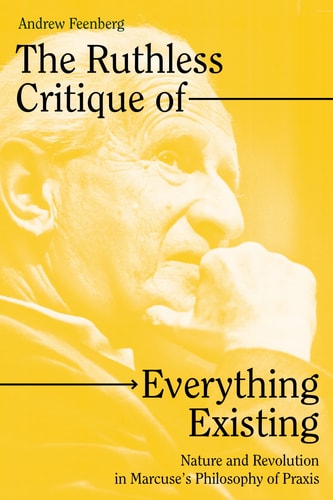
The Ruthless Critique of Everything Existing: Nature and Revolution in Marcuse’s Philosophy of Praxis
0
0
As an Amazon Associate and affiliate partner, Menrva Books earns from qualifying purchases. Learn more
Author Description
How Marcuse helps us understand the ecological crisis of the 21st century For several years after 1968, Herbert Marcuse was one of the most famous philosophers in the world. He became the face of Frankfurt School Critical Theory for a generation in turmoil. His fame rested on two remarkable books, Eros and Civilization and One-Dimensional Man. These two books represent the utopian hopes and dystopian fears of the time. In the 1960s and 70s, young people seeking a theoretical basis for their revolution found it in his work. Marcuse not only supported their struggles against imperialism and race and gender discrimination, he foresaw the far-reaching implications of the destruction of the natural environment. Marcuse’s Marxism was influenced by Husserl and Heidegger, Hegel and Freud. These eclectic sources grounded an original critique of advanced capitalism focused on the social construction of subjectivity and technology. Marcuse contrasted the “one-dimensionality” of conformist experience with the “new sensibility” of the New Left. The movement challenged a society that “delivered the goods” but devastated the planet with its destructive science and technology. A socialist revolution would fail if it did not transform these instruments into means of liberation, both of nature and human beings. This aspiration is alive today in the radical struggle over climate change. Marcuse offers theoretical resources for understanding that struggle.
Menrva's Summary
THE THESIS
This book investigates how Herbert Marcuse's philosophy of praxis offers critical insights into the 21st-century ecological crisis. Andrew Feenberg's work examines Marcuse's intellectual legacy, particularly his critiques of advanced capitalism and his concept of a 'new sensibility.' The book explores how Marcuse's ideas, influenced by thinkers like Hegel, Freud, Husserl, and Heidegger, provide theoretical resources for understanding the radical struggles surrounding climate change and the need to transform destructive science and technology into instruments of liberation for both humanity and nature.
THE SCOPE MAP
- An analysis of Herbert Marcuse's philosophical development and key works, including 'Eros and Civilization' and 'One-Dimensional Man'.
- Exploration of Marcuse's critique of advanced capitalism, focusing on the social construction of subjectivity and technology.
- Discussion of the contrast between 'one-dimensionality' and the 'new sensibility' of the New Left.
- Examination of Marcuse's foresight regarding the environmental implications of industrial society.
- Connections drawn between Marcuse's theories and contemporary radical struggles over climate change.
- Theoretical resources for understanding the liberation of nature and human beings through transformed science and technology.
THE AUTHORITY PERSPECTIVE
This book is positioned as a significant contribution to understanding Herbert Marcuse's relevance to contemporary environmental and social issues. By connecting his philosophical framework to the ecological crisis, it aims to provide theoretical grounding for current activist movements. The work is likely to appeal to scholars and students of critical theory, environmental philosophy, and political thought seeking to engage with Marcuse's enduring legacy.
Page Count:
256
Publication Date:
2023-02-28
Publisher:
Verso Books
ISBN-10:
1804290831
ISBN-13:
9781804290835
Philosophy
Non-Fiction
Social Theory
Political Theory
Critical Theory
Community Tags
Similar Books