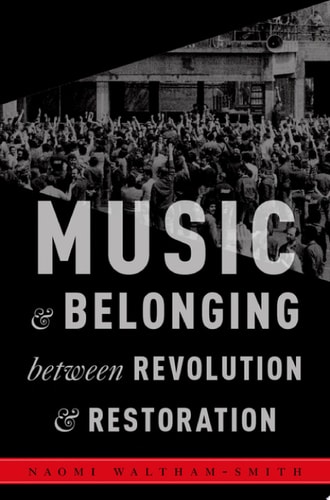
Music and Belonging Between Revolution and Restoration
0
0
As an Amazon Associate and affiliate partner, Menrva Books earns from qualifying purchases. Learn more
Author Description
In what ways is music implicated in the politics of belonging? How is the proper at stake in listening? What role does the ear play in forming a sense of community? Music and Belonging argues that music, at the level of style and form, produces certain modes of listening that in turn reveal the conditions of belonging. Specifically, listening shows the intimacy between two senses of belonging: belonging to a community is predicated on the possession of a particular property or capacity.Somewhat counter-intuitively, Waltham-Smith suggests that this relation between belonging-as-membership and belonging-as-ownership manifests itself with particular clarity and rigor at the very heart of the Austro-German canon, in the instrumental music of Haydn, Mozart, and Beethoven. Music and Belonging provocatively brings recent European philosophy into contact with the renewed music-theoretical interest in Formenlehre, presenting close analyses to show how we might return to this much-discussed repertoire to mine it for fresh insights.The book's theoretical landscape offers a radical update to Adornian-inspired scholarship, working through debates over relationality, community, and friendship between Derrida, Nancy, Agamben, Badiou, and Malabou. Borrowing the deconstructive strategies of closely reading canonical texts to the point of their unraveling, the book teases out a new politics of listening from processes of repetition and liquidation, from harmonic suppressions and even from trills. What emerges is the enduring political significance of listening to this music in an era of heightened social exclusion under neoliberalism.
Menrva's Summary
THE THESIS
This book investigates how music, specifically within the Austro-German canon, functions as a mechanism for defining and challenging the politics of belonging. Naomi Waltham-Smith, a scholar of music theory and philosophy, utilizes a framework that synthesizes recent European continental philosophy with traditional music-theoretical analysis. She argues that the structural elements of instrumental music—such as repetition, liquidation, and harmonic suppression—reveal the inherent tensions between belonging as community membership and belonging as property ownership.
THE SCOPE MAP
What You Will Find
- Analysis of instrumental works by Haydn, Mozart, and Beethoven.
- A theoretical synthesis of works by Derrida, Nancy, Agamben, Badiou, and Malabou.
- Application of deconstructive reading strategies to music theory and Formenlehre.
Scope Limits
- The analysis is primarily restricted to the Austro-German classical canon.
- The text does not provide a broad historical survey of music outside of the specific philosophical and theoretical framework presented.
THE AUTHORITY PERSPECTIVE
Scholars and music theorists frequently note the high level of academic density and the sophisticated integration of post-structuralist philosophy within this text. It is regarded as a significant contribution to contemporary musicology that challenges traditional interpretations of canonical instrumental works.
Page Count:
278
Publication Date:
2017-01-01
Publisher:
Oxford University Press
ISBN-10:
0190662026
ISBN-13:
9780190662028
Philosophy
Political Theory
Humanities
Music History
Music Technology
Musicology
Critical Theory