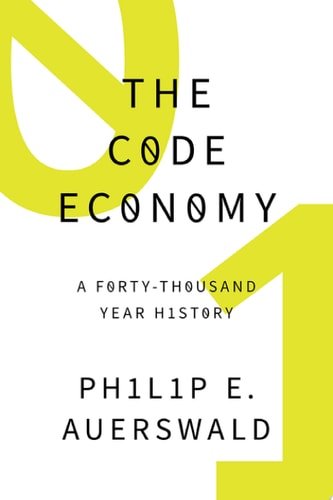
The Code Economy
0
0
As an Amazon Associate and affiliate partner, Menrva Books earns from qualifying purchases. Learn more
Author Description
What Do Stone Age Axes, Toll House Cookies, And Burning Man Have In Common? They Are All Examples Of Code In Action. What Is Code? Code Is The Dna Of Human Civilization As It Has Evolved From Neolithic Simplicity To Modern Complexity. It Is The How Of Progress. It Is How Ideas Become Things, How Ingredients Become Cookies. It Is How Cities Are Created And How Industries Develop. In A Sweeping Narrative That Takes Readers From The Invention Of The Alphabet To The Advent Of The Blockchain, Philip Auerswald Argues That The Advance Of Code Is The Key Driver Of Human History. Over The Span Of Centuries, Each Major Stage In The Advance Of Code Has Brought A Shift In The Structure Of Society That Has Challenged Human Beings To Reinvent Not Only How We Work But Who We Are. We Are In Another Of Those Stages Now. The Code Economy Explains How The Advance Of Code Is Once Again Fundamentally Altering The Nature Of Work And The Human Experience. Auerswald Provides A Timely Investigation Of Value Creation In The Contemporary Economy-and An Indispensable Guide To Our Economic Future.
Menrva's Summary
THE THESIS
Philip E. Auerswald investigates the core question of how the evolution of 'code'—defined as the fundamental instructions for human progress—has served as the primary driver of societal structure and economic value throughout history. Auerswald, a professor and expert in innovation policy, utilizes a historical framework to trace the development of human civilization from Neolithic tools to modern digital systems. He argues that each major advancement in code forces a systemic reinvention of human labor and identity, positioning our current digital era as a critical inflection point in this ongoing process.
THE SCOPE MAP
What You Will Find
- A historical analysis of technological and social development from the invention of the alphabet to blockchain technology.
- A conceptual framework defining 'code' as the DNA of human civilization and the mechanism for turning ideas into tangible reality.
- An examination of how shifts in code-based systems fundamentally alter the nature of work and economic value creation.
Scope Limits
- The book does not provide a technical manual for software programming or specific coding languages.
- It does not offer a predictive forecast of specific stock market trends or short-term economic fluctuations.
THE AUTHORITY PERSPECTIVE
Experts and readers frequently note the book's broad historical scope and its ability to synthesize complex economic concepts into a cohesive narrative. It is widely regarded as a useful framework for understanding the structural shifts in the modern economy driven by technological change.
Page Count:
256
Publication Date:
2017-01-01
Publisher:
Oxford University Press
ISBN-10:
0190226773
ISBN-13:
9780190226770
Economics
History
Business
Sociology
Technology
Innovation
Community Tags
Similar Books