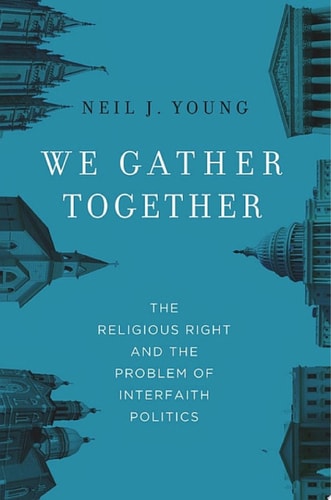
We Gather Together: The Religious Right and the Problem of Interfaith Politics
0
0
As an Amazon Associate and affiliate partner, Menrva Books earns from qualifying purchases. Learn more
Author Description
The story of the birth of the Religious Right is a familiar one. In the 1970s, mainly in response to Roe v. Wade, evangelicals and conservative Catholics put aside their longstanding historical prejudices and theological differences and joined forces to form a potent political movement that swept across the country. In this provocative book, Neil J. Young argues that almost none of this is true. Young offers an alternative history of the Religious Right that upends these widely-believed myths. Theology, not politics, defined the Religious Right. The rise of secularism, pluralism, and cultural relativism, Young argues, transformed the relations of America's religious denominations. The interfaith collaborations among liberal Protestants, Catholics, and Jews were met by a conservative Christian counter-force, which came together in a loosely bound, politically-minded coalition known as the Religious Right. This right-wing religious movement was made up of Mormons, conservative Catholics, and evangelicals, all of whom were united -- paradoxically -- by their contempt for the ecumenical approach they saw the liberal denominations taking. Led by the likes of Jerry Falwell, they deemed themselves the "pro-family" movement, and entered full-throated into political debates about abortion, school prayer, the Equal Rights Amendment, gay rights, and tax exemptions for religious schools. They would go on to form a critical new base for the Republican Party. Examining the religious history of interfaith dialogue among conservative evangelicals, Catholics, and Mormons, Young argues that the formation of the Religious Right was not some brilliant political strategy hatched on the eve of a history-altering election but rather the latest iteration of a religious debate that had gone on for decades. This path breaking book will reshape our understanding of the most important religious and political movement of the last 30 years.
Menrva's Summary
THE THESIS
This book investigates the origins of the Religious Right by challenging the conventional narrative that it was a purely political reaction to 1970s social issues. Neil J. Young, a historian of American religion, utilizes archival research and historical analysis to argue that the movement was fundamentally driven by theological debates rather than political strategy. He posits that the coalition of evangelicals, Catholics, and Mormons emerged as a reactionary force against the rise of secularism and the interfaith ecumenism practiced by liberal denominations.
THE SCOPE MAP
What You Will Find
- Historical analysis of the mid-20th-century shift in American religious denominations.
- Examination of the theological tensions between conservative and liberal religious groups.
- Case studies on the formation of the "pro-family" movement and its integration into the Republican Party.
- Documentation of the role of figures such as Jerry Falwell in shaping conservative religious identity.
Scope Limits
- The text does not provide a comprehensive biography of individual political leaders.
- It does not focus on the internal administrative structures of the Republican Party beyond its relationship with religious groups.
THE AUTHORITY PERSPECTIVE
Scholars and historians frequently cite this work for its nuanced re-evaluation of the intersection between American religious history and political mobilization. Readers often note the academic rigor of the prose, which provides a sophisticated alternative to popular political narratives.
Page Count:
0
Publication Date:
2015-11-02
Publisher:
Oxford University Press, Incorporated
ISBN-10:
0190262346
ISBN-13:
9780190262341
History
Religion
Politics
Jesus Christ
Sociology
United States
American History
Community Tags
Other Editions(2)
Similar Books


Reader Comments
Share Your Thoughts
No comments yet. Be the first to share your thoughts!