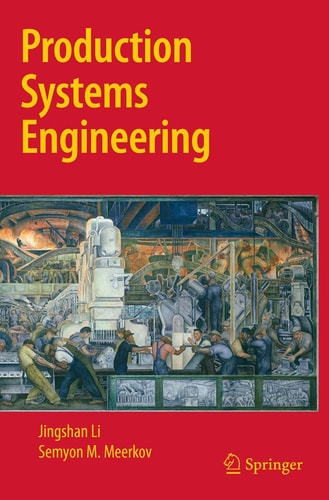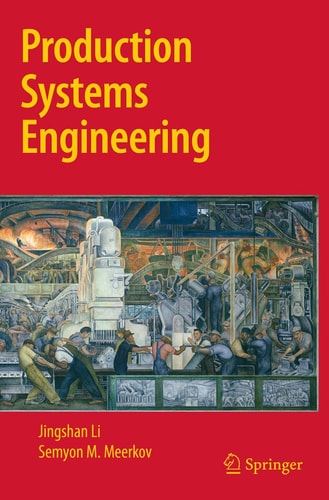
Production Systems Engineering
0
0
As an Amazon Associate and affiliate partner, Menrva Books earns from qualifying purchases. Learn more
Author Description
Production Systems Engineering (PSE) is an emerging branch of Engineering intended to uncover fundamental principles of production systems and utilize them for analysis, continuous improvement, and design. This volume is the first ever textbook devoted exclusively to PSE. It is intended for senior undergraduate and first year graduate students interested in manufacturing. The development is first principle-based rather than recipe-based. The only prerequisite is elementary Probability Theory; however, all necessary probability facts are reviewed in an introductory chapter. Using a system-theoretic approach, this textbook provides analytical solutions for the following problems: mathematical modeling of production systems, performance analysis, constrained improvability, bottleneck identification and elimination, lean buffer design, product quality, customer demand satisfaction, transient behavior, and system-theoretic properties. Numerous case studies are presented. In addition, the so-called PSE Toolbox, which implements the algorithms developed, is described. The volume includes numerous case studies and problems for homework assignment.
Menrva's Summary
THE THESIS
This textbook introduces Production Systems Engineering (PSE) as a distinct field focused on uncovering and applying fundamental principles to the analysis, improvement, and design of production systems. The authors, Jingshan Li and Semyon M. Meerkov, present PSE as a first-principle-based discipline, requiring only elementary Probability Theory as a prerequisite, with necessary concepts reviewed in an introductory chapter. Employing a system-theoretic approach, the book offers analytical solutions for critical aspects of production systems, including mathematical modeling, performance analysis, bottleneck identification, and quality management, supported by numerous case studies.
THE SCOPE MAP
- Mathematical modeling of production systems
- Performance analysis and constrained improvability
- Bottleneck identification and elimination
- Lean buffer design principles
- Analysis of product quality and customer demand satisfaction
- Understanding transient behavior in production systems
- Application of system-theoretic properties
- Description of the PSE Toolbox for algorithm implementation
THE AUTHORITY PERSPECTIVE
This textbook is positioned as the first dedicated volume to the emerging field of Production Systems Engineering (PSE), targeting senior undergraduate and first-year graduate students in manufacturing. The approach is analytical and principle-based, distinguishing it from more prescriptive methods. The inclusion of numerous case studies and a practical PSE Toolbox suggests a strong emphasis on applied learning and problem-solving within the academic context.
Page Count:
666
Publication Date:
2010-11-05
Publisher:
Springer US
ISBN-10:
1441945377
ISBN-13:
9781441945372
Science & Technology
Non-Fiction
Manufacturing
Engineering
Operations Research
Probability Theory