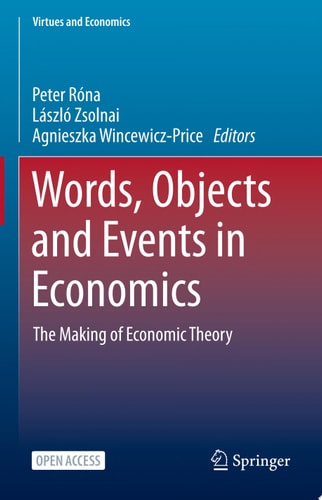
Words, Objects and Events in Economics: The Making of Economic Theory
0
0
As an Amazon Associate and affiliate partner, Menrva Books earns from qualifying purchases. Learn more
Author Description
This open access book examines from a variety of perspectives the disappearance of moral content and ethical judgment from the models employed in the formulation of modern economic theory, and some of the papers contain important proposals about how moral judgment could be reintroduced in economic theory. The chapters collected in this volume result from the favorable reception of the first volume of the Virtues in Economics series and represent further contributions to the themes set out in that volume: (i) examining the philosophical and methodological fallacies of this turn in modern economic theory that the removal of the moral motivation of economic agents from modern economic theory has entailed; and (ii) proposing a return descriptive economics as the means with which the moral content of economic life could be restored in economic theory. This book is of interest to researchers and students of the methodology of economics, ethics, philosophers concerned with agency and economists who build economic models that rest in the intention of the agent.
Menrva's Summary
THE THESIS
This book investigates the ethical and methodological shortcomings of modern economic theory that arise from the exclusion of moral content. It examines the philosophical fallacies behind this trend and proposes methods for reintroducing ethical judgment into economic models, drawing on descriptive economics to restore the moral dimension of economic life. The chapters are a continuation of the themes from the first volume of the Virtues in Economics series, focusing on the consequences of removing moral motivations from economic agents and offering potential solutions for a more ethically grounded economic framework.
THE SCOPE MAP
- Examination of the disappearance of moral content and ethical judgment from modern economic theory.
- Analysis of the philosophical and methodological fallacies of this exclusion.
- Proposals for reintroducing moral judgment into economic theory.
- Emphasis on descriptive economics as a means to restore moral content.
- Contributions from various perspectives on the Virtues in Economics series.
- Focus on the intention of the agent in economic modeling.
THE AUTHORITY PERSPECTIVE
This collection is of interest to researchers and students of economic methodology and ethics, as well as philosophers concerned with agency. The chapters represent further contributions to themes explored in the first volume of the Virtues in Economics series, indicating a continued academic dialogue on the subject. The work aims to address the perceived lack of moral content in contemporary economic models and offers potential avenues for its restoration.
Page Count:
226
Publication Date:
2020-09-03
Publisher:
Springer Nature
ISBN-10:
3030526739
ISBN-13:
9783030526733
Philosophy
Economics
Non-Fiction
Ethics
Community Tags
Similar Books