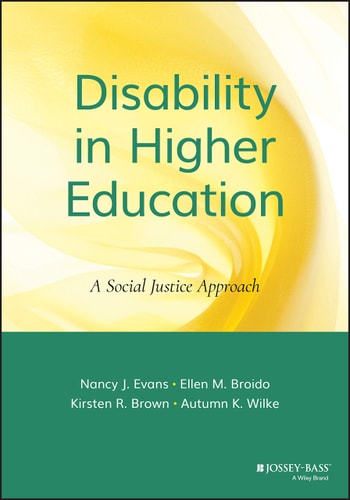
Disability in Higher Education: A Social Justice Approach
0
0
As an Amazon Associate and affiliate partner, Menrva Books earns from qualifying purchases. Learn more
Author Description
Create campuses inclusive and supportive of disabled students, staff, and faculty Disability in Higher Education: A Social Justice Approach examines how disability is conceptualized in higher education and ways in which students, faculty, and staff with disabilities are viewed and served on college campuses. Drawing on multiple theoretical frameworks, research, and experience creating inclusive campuses, this text offers a new framework for understanding disability using a social justice lens. Many institutions focus solely on legal access and accommodation, enabling a system of exclusion and oppression. However, using principles of universal design, social justice, and other inclusive practices, campus environments can be transformed into more inclusive and equitable settings for all constituents. The authors consider the experiences of students, faculty, and staff with disabilities and offer strategies for addressing ableism within a variety of settings, including classrooms, residence halls, admissions and orientation, student organizations, career development, and counseling. They also expand traditional student affairs understandings of disability issues by including chapters on technology, law, theory, and disability services. Using social justice principles, the discussion spans the entire college experience of individuals with disabilities, and avoids any single-issue focus such as physical accessibility or classroom accommodations. The book will help readers: Consider issues in addition to access and accommodation Use principles of universal design to benefit students and employees in academic, cocurricular, and employment settings Understand how disability interacts with multiple aspects of identity and experience. Despite their best intentions, college personnel frequently approach disability from the singular perspective of access to the exclusion of other important issues. This book
Menrva's Summary
THE THESIS
This book challenges traditional approaches to disability in higher education by advocating for a social justice framework. The authors, drawing on theory, research, and practical experience, propose a new model for understanding disability that moves beyond mere legal access and accommodation. They argue that by embracing principles of universal design and social justice, institutions can create more equitable and inclusive environments for all students, faculty, and staff. The text examines the multifaceted experiences of individuals with disabilities across their entire college journey, integrating disability with other aspects of identity.
THE SCOPE MAP
- Analysis of how disability is conceptualized within higher education.
- Application of social justice principles and universal design to create inclusive campuses.
- Strategies for addressing ableism in various campus settings (classrooms, residence halls, admissions, etc.).
- Consideration of disability in conjunction with other identity factors.
- Inclusion of chapters on technology, law, theory, and disability services.
- A framework that spans the entire college experience for individuals with disabilities.
THE AUTHORITY PERSPECTIVE
This book is regarded as a significant contribution to the field of disability studies in higher education, offering a much-needed social justice perspective. It moves beyond a compliance-based approach to disability, encouraging institutions to foster genuine inclusion and equity. The authors' integration of theory, research, and practical strategies provides a comprehensive guide for transforming campus environments. The text is valuable for educators, administrators, and anyone involved in creating more supportive and accessible higher education settings.
Page Count:
544
Publication Date:
2017-03-06
Publisher:
John Wiley & Sons
ISBN-10:
1118018222
ISBN-13:
9781118018224
Non-Fiction
Accessibility
Social justice
Higher Education
Inclusion
Community Tags
Other Editions(2)
Similar Books









Reader Comments
Share Your Thoughts
No comments yet. Be the first to share your thoughts!