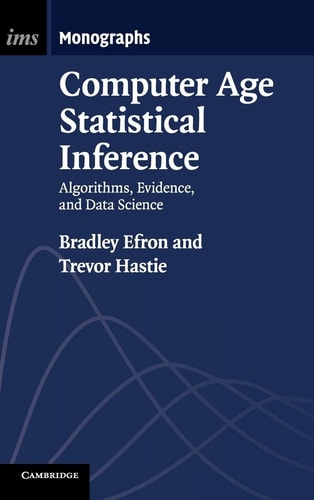
Computer Age Statistical Inference
0
0
As an Amazon Associate and affiliate partner, Menrva Books earns from qualifying purchases. Learn more
Author Description
The twenty-first century has seen a breathtaking expansion of statistical methodology, both in scope and in influence. 'Big data', 'data science', and 'machine learning' have become familiar terms in the news, as statistical methods are brought to bear upon the enormous data sets of modern science and commerce. How did we get here? And where are we going? This book takes us on an exhilarating journey through the revolution in data analysis following the introduction of electronic computation in the 1950s. Beginning with classical inferential theories - Bayesian, frequentist, Fisherian - individual chapters take up a series of influential topics: survival analysis, logistic regression, empirical Bayes, the jackknife and bootstrap, random forests, neural networks, Markov chain Monte Carlo, inference after model selection, and dozens more. The distinctly modern approach integrates methodology and algorithms with statistical inference. The book ends with speculation on the future direction of statistics and data science.
Menrva's Summary
THE THESIS
The twenty-first century has witnessed a profound expansion in statistical methodology, driven by the advent of electronic computation and the proliferation of 'big data'. This book traces the evolution of data analysis from the mid-20th century onwards, exploring the classical inferential theories and the subsequent development of influential topics such as survival analysis, logistic regression, the bootstrap, random forests, and neural networks. It integrates modern computational methods with statistical inference, offering insights into the current landscape of data science and speculating on its future trajectory.
THE SCOPE MAP
- Exploration of classical inferential theories: Bayesian, frequentist, and Fisherian.
- Detailed chapters on influential topics including survival analysis, logistic regression, and empirical Bayes.
- Coverage of resampling methods like the jackknife and bootstrap.
- Introduction to modern algorithms such as random forests and neural networks.
- Discussion of Markov chain Monte Carlo methods.
- Analysis of inference after model selection.
- Integration of methodology and algorithms with statistical inference.
- Speculation on the future directions of statistics and data science.
THE AUTHORITY PERSPECTIVE
The book is recognized for its comprehensive overview of statistical inference in the computer age, charting the revolution in data analysis spurred by computational advancements. It is lauded for its integration of modern computational techniques with foundational statistical theories, covering a wide array of influential topics. The text is structured to guide readers through the historical development and current state of data science, making it a valuable resource for understanding the field's evolution and potential future. Its approach is noted for bridging the gap between theoretical statistics and practical algorithmic applications.
Page Count:
475
Publication Date:
2016-07-21
Publisher:
Cambridge University Press
ISBN-10:
1107149894
ISBN-13:
9781107149892
Non-Fiction
Science
Computer Science
Statistics
Data Science
Machine Learning
Community Tags
Similar Books