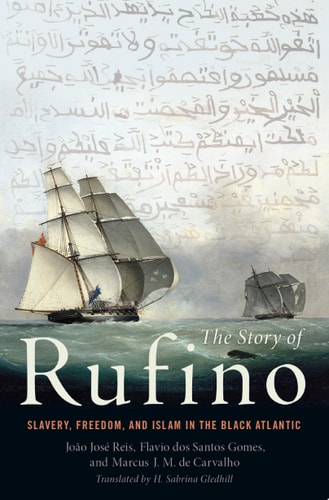
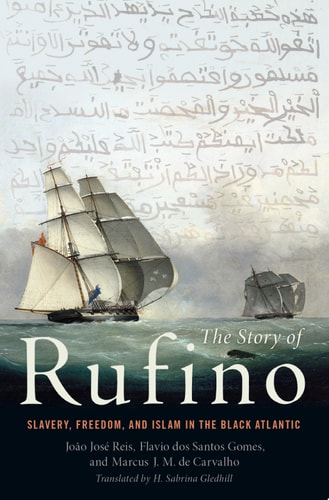
The Story of Rufino: Slavery, Freedom, and Islam in the Black Atlantic
0
0
As an Amazon Associate and affiliate partner, Menrva Books earns from qualifying purchases. Learn more
Author Description
Winner of the Casa de las América Prize for Brazilian Literature, The Story of Rufino reconstructs the lively biography of Rufino José Maria, set against the historical context of Brazil and Africa in the nineteenth century.The book tells the story of Rufino or Abuncare, a Yoruba Muslim from the kingdom of Oyo, in present-day Nigeria. Enslaved as an adolescent by a rival ethnic group, he was captured by Brazilian slave traders and taken to Brazil as a slave sometime in the early 1820s. In 1835, after being enslaved in Salvador and Rio Grande do Sul, Rufino bought his freedom with money he made as a hired-out slave and perhaps from making Islamic amulets. He found work in Rio de Janeiro as a cook on a slave ship bound for Luanda in Angola, despite the trans-Atlantic slave trade having been illegal in Brazil since 1831. Rufino himself became a petty slave trader. He made a few voyages before his ship was captured by the British and taken to Sierra Leone in 1841 for trial by the Anglo-Brazilian Mixed Commission to determine if it was equipped for the slave trade, since there were no slaves on board. During the three months awaiting the court's decision, Rufino lived among Yoruba Muslims, his people, and attended Quranic and Arabic classes. He later returned to Sierra Leone as a witness in a court case and attended classes with Muslim masters for almost two years. Once back in Brazil, he established himself as a diviner -- serving whites and blacks, free and slaves, Brazilians and Africans, Muslim and non-Muslims -- as well as a spiritual leader, an Alufa, in the local Afro-Muslim community. In 1853 Rufino was arrested due to rumors of an imminent African slave revolt. The police used as evidence for his arrest the large number of Arabic manuscripts in his possession, the same kind of material the police had found with Muslim rebels in Bahia thirty years earlier. During his interrogation, Rufino told his life story, which is used to reconstruct the world in which he liv
Menrva's Summary
THE THESIS
This work investigates the life and experiences of Rufino José Maria to illuminate the complex intersections of slavery, freedom, and Islamic identity within the nineteenth-century Black Atlantic. The authors, Flávio dos Santos Gomes, Marcus J. M. de Carvalho, and João José Reis, utilize archival records and Rufino’s own interrogation testimony to reconstruct his trajectory from a Yoruba captive to a prominent spiritual leader in Brazil. By analyzing his movements across the Atlantic, the text argues that individuals like Rufino navigated and shaped the social, religious, and economic landscapes of the slave trade era through agency and cultural resilience.
THE SCOPE MAP
What You Will Find
- Detailed reconstruction of the nineteenth-century trans-Atlantic slave trade routes between Nigeria, Brazil, and Angola.
- Analysis of the socio-religious role of Yoruba Muslims and the Alufa in Afro-Brazilian communities.
- Examination of legal proceedings involving the Anglo-Brazilian Mixed Commission in Sierra Leone.
- Insights into the practice of divination and the circulation of Arabic manuscripts as cultural and political markers.
Scope Limits
- The narrative is constrained by the availability of primary source documentation, specifically relying heavily on Rufino’s own testimony during his 1853 interrogation.
- The book does not provide a comprehensive history of all Yoruba Muslim communities in Brazil, focusing primarily on the specific experiences of Rufino.
THE AUTHORITY PERSPECTIVE
Experts recognize this work as a significant contribution to the study of the African diaspora, praising the authors for their meticulous archival research and ability to contextualize an individual life within broader historical currents. Readers frequently note the academic density of the prose, which provides a rigorous examination of the social and political complexities inherent in the nineteenth-century Atlantic world.
Page Count:
319
Publication Date:
2019-01-01
Publisher:
Oxford University Press
ISBN-10:
019022438X
ISBN-13:
9780190224387
Biography
History
Nineteenth century
Slavery
American History
Special Topics
African history
Brazil
Islam
Community Tags
Similar Books

Reader Comments
Share Your Thoughts
No comments yet. Be the first to share your thoughts!