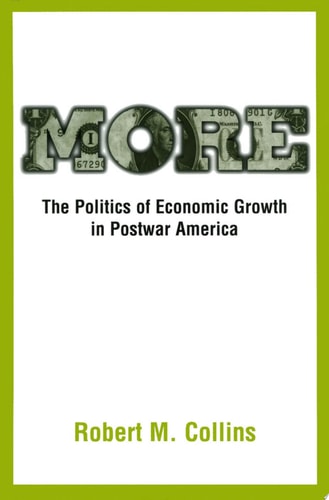
More: The Politics of Economic Growth in Postwar America
0
0
As an Amazon Associate and affiliate partner, Menrva Books earns from qualifying purchases. Learn more
Author Description
James Carville famously reminded Bill Clinton throughout 1992 that "it's the economy, stupid." Yet, for the last forty years, historians of modern America have ignored the economy to focus on cultural, social, and political themes, from the birth of modern feminism to the fall of the Berlin Wall. Now a scholar has stepped forward to place the economy back in its rightful place, at the center of his historical narrative.In More, Robert M. Collins reexamines the history of the United States from Franklin Delano Roosevelt to Bill Clinton, focusing on the federal government's determined pursuit of economic growth. After tracing the emergence of growth as a priority during FDR's presidency, Collins explores the record of successive administrations, highlighting both their success in fostering growth and its partisan uses. Collins reveals that the obsession with growth appears not only as a matter of policy, but as an expression of Cold War ideology--both a means to pay for the arms build-up and proof of the superiority of the United States' market economy. But under Johnson, this enthusiasm sparked a crisis: spending on Vietnam unleashed runaway inflation, while the nation struggled with the moral consequences of its prosperity, reflected in books such as John Kenneth Galbraith's The Affluent Society and Rachel Carson's Silent Spring. More continues up to the end of the 1990s, as Collins explains the real impact of Reagan's policies and astutely assesses Clinton's "disciplined growthmanship," which combined deficit reduction and a relaxed but watchful monetary policy by the Federal Reserve.Writing with eloquence and analytical clarity, Robert M. Collins offers a startlingly new framework for understanding the history of postwar America.
Menrva's Summary
THE THESIS
This book investigates how the pursuit of economic growth became the central organizing principle of American federal policy and Cold War ideology from the Roosevelt administration through the Clinton era. Robert M. Collins, a historian of modern America, utilizes a political-economic framework to analyze how successive administrations leveraged growth as both a domestic policy tool and a demonstration of capitalist superiority. He argues that this obsession with expansion shaped the nation's response to global conflicts, social movements, and internal fiscal crises.
THE SCOPE MAP
What You Will Find
- A chronological analysis of federal economic policy from the New Deal to the late 1990s.
- Examination of the intersection between Cold War military spending and domestic economic growth.
- Discussion of the political consequences of inflation and the moral critiques of prosperity.
Scope Limits
- The text does not provide a comprehensive history of social or cultural movements independent of their relationship to economic policy.
- It does not offer a technical manual for modern macroeconomic forecasting or financial management.
THE AUTHORITY PERSPECTIVE
Scholars and historians recognize this work as a significant contribution to the study of postwar American political economy. Readers frequently note the clarity of the author's prose and the effectiveness of his argument in re-centering economic policy within the broader historical narrative of the twentieth century.
Page Count:
314
Publication Date:
2002-01-01
Publisher:
Oxford University Press
ISBN-10:
0190288264
ISBN-13:
9780190288266
History
Economics
Liberalism
Public Policy
United States
American History
Postwar America
Wealth
National characteristics American
Community Tags
Other Editions(2)

Similar Books