Embedded Artificial Intelligence
0
0
As an Amazon Associate and affiliate partner, Menrva Books earns from qualifying purchases. Learn more
Author Description
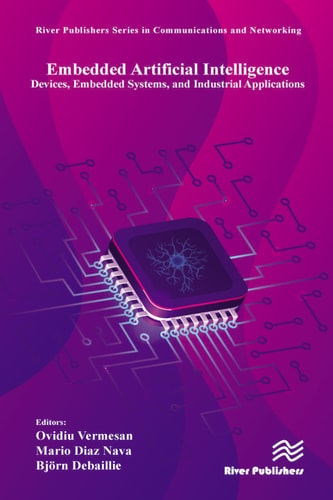
Recent technological developments in sensors, edge computing, connectivity, and artificial intelligence (AI) technologies have accelerated the integration of data analysis based on embedded AI capabilities into resource-constrained, energy-efficient hardware devices for processing information at the network edge. Embedded AI combines embedded machine learning (ML) and deep learning (DL) based on neural networks (NN) architectures such as convolutional NN (CNN), or spiking neural network (SNN) and algorithms on edge devices and implements edge computing capabilities that enable data processing and analysis without optimised connectivity and integration, allowing users to access data from various sources. Embedded AI efficiently implements edge computing and AI processes on resource-constrained devices to mitigate downtime and service latency, and it successfully merges AI processes as a pivotal component in edge computing and embedded system devices. Embedded AI also enables users to reduce costs, communication, and processing time by assembling data and by supporting user requirements without the need for continuous interaction with physical locations. This book provides an overview of the latest research results and activities in industrial embedded AI technologies and applications, based on close cooperation between three large-scale ECSEL JU projects, AI4DI, ANDANTE, and TEMPO. The book’s content targets researchers, designers, developers, academics, post-graduate students and practitioners seeking recent research on embedded AI. It combines the latest developments in embedded AI, addressing methodologies, tools, and techniques to offer insight into technological trends and their use across different industries.
Menrva's Summary
THE THESIS
This book investigates the integration of artificial intelligence into resource-constrained hardware devices for edge computing. It explores how recent advancements in sensors, edge computing, connectivity, and AI technologies enable data analysis on embedded AI capabilities. The work details the combination of embedded machine learning and deep learning, utilizing neural network architectures like CNNs and SNNs, to process information at the network edge. This integration aims to mitigate downtime, reduce service latency, and decrease costs by enabling efficient data assembly and processing without constant physical interaction.
THE SCOPE MAP
- Overview of the latest research results and activities in industrial embedded AI technologies and applications.
- Based on cooperation between three large-scale ECSEL JU projects: AI4DI, ANDANTE, and TEMPO.
- Content targets researchers, designers, developers, academics, post-graduate students, and practitioners.
- Combines the latest developments in embedded AI, addressing methodologies, tools, and techniques.
- Offers insight into technological trends and their use across different industries.
- Explores embedded machine learning (ML) and deep learning (DL) on edge devices.
- Discusses neural network architectures such as convolutional NN (CNN) and spiking neural network (SNN).
- Focuses on implementing edge computing capabilities for data processing without optimized connectivity.
THE AUTHORITY PERSPECTIVE
The book is presented as a compilation of recent research from three major ECSEL JU projects, targeting a professional and academic audience. Its focus on industrial embedded AI technologies and applications suggests a technical and in-depth exploration of methodologies, tools, and trends. The content is designed to provide insight into the practical implementation and future directions of AI at the network edge. The collaborative nature of its creation implies a comprehensive overview of current advancements in the field.
Page Count:
336
Publication Date:
2023-05-05
Publisher:
Taylor & Francis
ISBN-10:
1000882039
ISBN-13:
9781000882032
Non-Fiction
Science
Technology
Industrial Applications
Engineering
Machine Learning
Computer Science
Community Tags
Similar Books