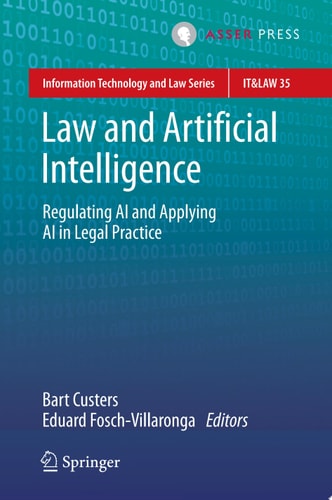
Law and Artificial Intelligence
0
0
As an Amazon Associate and affiliate partner, Menrva Books earns from qualifying purchases. Learn more
Author Description
This book provides an in-depth overview of what is currently happening in the field of Law and Artificial Intelligence (AI). From deep fakes and disinformation to killer robots, surgical robots, and AI lawmaking, the many and varied contributors to this volume discuss how AI could and should be regulated in the areas of public law, including constitutional law, human rights law, criminal law, and tax law, as well as areas of private law, including liability law, competition law, and consumer law. Aimed at an audience without a background in technology, this book covers how AI changes these areas of law as well as legal practice itself. This scholarship should prove of value to academics in several disciplines (e.g., law, ethics, sociology, politics, and public administration) and those who may find themselves confronted with AI in the course of their work, particularly people working within the legal domain (e.g., lawyers, judges, law enforcement officers, public prosecutors, lawmakers, and policy advisors). Bart Custers is Professor of Law and Data Science at eLaw - Center for Law and Digital Technologies at Leiden University in the Netherlands. Eduard Fosch-Villaronga is Assistant Professor at eLaw - Center for Law and Digital Technologies at Leiden University in the Netherlands.
Menrva's Summary
THE THESIS
This book investigates the complex and rapidly evolving intersection of artificial intelligence and the legal landscape. The authors, professors at Leiden University, explore how AI technologies, from deep fakes to autonomous systems, challenge existing legal frameworks. They examine the regulation of AI across public law domains such as constitutional law, human rights, criminal law, and tax law, as well as private law areas including liability, competition, and consumer law. The work aims to clarify how AI is transforming legal practice and the law itself for a broad audience.
THE SCOPE MAP
- An overview of current developments in Law and Artificial Intelligence.
- Discussion of AI regulation in public law, including constitutional, human rights, criminal, and tax law.
- Analysis of AI's impact on private law areas like liability, competition, and consumer law.
- Examination of emerging AI-related issues such as deep fakes, disinformation, and autonomous systems.
- Insights into how AI is changing legal practice and the legal profession.
- Contributions from various experts in the field of law and technology.
THE AUTHORITY PERSPECTIVE
This scholarly work is positioned as an in-depth overview for academics and legal professionals grappling with the implications of artificial intelligence. Its comprehensive scope, addressing both public and private law, suggests a text that aims to provide a foundational understanding of AI's legal challenges. The authors' academic credentials and the book's focus on regulation indicate a serious, analytical approach to the subject matter.
Page Count:
569
Publication Date:
2022-07-05
Publisher:
Springer Nature
ISBN-10:
9462655235
ISBN-13:
9789462655232
Non-Fiction
Science & Technology
Technology
Ethics
Law
Public Law
Private Law
Community Tags
Similar Books