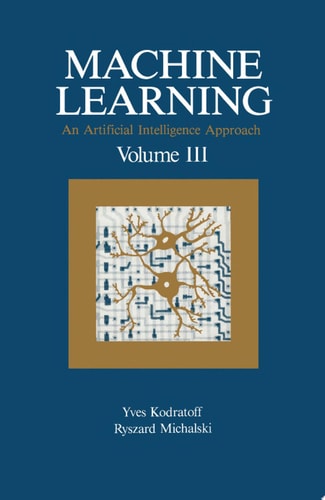
Machine Learning: An Artificial Intelligence Approach, Volume III
0
0
As an Amazon Associate and affiliate partner, Menrva Books earns from qualifying purchases. Learn more
Author Description
Machine Learning: An Artificial Intelligence Approach, Volume III presents a sample of machine learning research representative of the period between 1986 and 1989. The book is organized into six parts. Part One introduces some general issues in the field of machine learning. Part Two presents some new developments in the area of empirical learning methods, such as flexible learning concepts, the Protos learning apprentice system, and the WITT system, which implements a form of conceptual clustering. Part Three gives an account of various analytical learning methods and how analytic learning can be applied to various specific problems. Part Four describes efforts to integrate different learning strategies. These include the UNIMEM system, which empirically discovers similarities among examples; and the DISCIPLE multistrategy system, which is capable of learning with imperfect background knowledge. Part Five provides an overview of research in the area of subsymbolic learning methods. Part Six presents two types of formal approaches to machine learning. The first is an improvement over Mitchell's version space method; the second technique deals with the learning problem faced by a robot in an unfamiliar, deterministic, finite-state environment.
Menrva's Summary
THE THESIS
This volume explores the landscape of machine learning research from the late 1980s, showcasing advancements in empirical and analytical learning methods. The book is structured into six parts, beginning with foundational issues in machine learning. Subsequent sections delve into new developments in empirical learning, including flexible learning concepts and systems like Protos and WITT, followed by analytical learning methods and their applications. The work also addresses the integration of diverse learning strategies, such as in the UNIMEM and DISCIPLE systems, and examines subsymbolic learning methods and formal approaches to machine learning, including enhancements to version space methods and robotic learning in finite-state environments.
THE SCOPE MAP
- Overview of general issues in machine learning.
- New developments in empirical learning methods (e.g., flexible learning concepts, Protos, WITT).
- Account of various analytical learning methods and their applications.
- Efforts to integrate different learning strategies (e.g., UNIMEM, DISCIPLE).
- Overview of research in subsymbolic learning methods.
- Formal approaches to machine learning, including improvements on Mitchell's version space method.
- Learning problem faced by a robot in a finite-state environment.
THE AUTHORITY PERSPECTIVE
This collection represents a significant snapshot of machine learning research between 1986 and 1989, offering insights into the state-of-the-art during that period. The organization into six parts allows for a structured exploration of diverse topics, from general issues to specific empirical, analytical, and subsymbolic methods. The inclusion of formal approaches and robotic learning further broadens the scope of the presented research. As a compilation of work from a specific era, it serves as a valuable historical document for understanding the evolution of artificial intelligence and machine learning.
Page Count:
825
Publication Date:
2014-06-28
Publisher:
Elsevier S & T
ISBN-10:
0080510558
ISBN-13:
9780080510552
Science
Non-Fiction
Computer Science
Machine Learning
Research
Community Tags
Similar Books