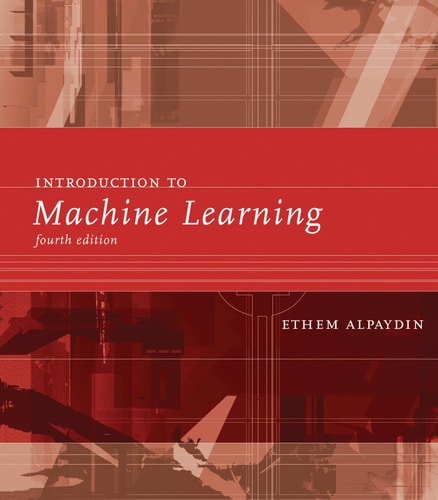
Introduction to Machine Learning
0
0
As an Amazon Associate and affiliate partner, Menrva Books earns from qualifying purchases. Learn more
Author Description
A substantially revised fourth edition of a comprehensive textbook, including new coverage of recent advances in deep learning and neural networks. The goal of machine learning is to program computers to use example data or past experience to solve a given problem. Machine learning underlies such exciting new technologies as self-driving cars, speech recognition, and translation applications. This substantially revised fourth edition of a comprehensive, widely used machine learning textbook offers new coverage of recent advances in the field in both theory and practice, including developments in deep learning and neural networks. The book covers a broad array of topics not usually included in introductory machine learning texts, including supervised learning, Bayesian decision theory, parametric methods, semiparametric methods, nonparametric methods, multivariate analysis, hidden Markov models, reinforcement learning, kernel machines, graphical models, Bayesian estimation, and statistical testing. The fourth edition offers a new chapter on deep learning that discusses training, regularizing, and structuring deep neural networks such as convolutional and generative adversarial networks; new material in the chapter on reinforcement learning that covers the use of deep networks, the policy gradient methods, and deep reinforcement learning; new material in the chapter on multilayer perceptrons on autoencoders and the word2vec network; and discussion of a popular method of dimensionality reduction, t-SNE. New appendixes offer background material on linear algebra and optimization. End-of-chapter exercises help readers to apply concepts learned. Introduction to Machine Learning can be used in courses for advanced undergraduate and graduate students and as a reference for professionals.
Menrva's Summary
THE THESIS
This textbook investigates the fundamental principles and practical applications of machine learning, aiming to equip readers with the ability to program computers to learn from data. The book details supervised learning, Bayesian decision theory, parametric and semiparametric methods, nonparametric methods, multivariate analysis, hidden Markov models, reinforcement learning, kernel machines, graphical models, Bayesian estimation, and statistical testing. It offers new coverage of deep learning, including training, regularizing, and structuring deep neural networks, as well as advancements in reinforcement learning and dimensionality reduction techniques like t-SNE. The text is structured to serve as both a course text for advanced undergraduate and graduate students and a reference for professionals.
THE SCOPE MAP
- Comprehensive coverage of supervised learning, Bayesian decision theory, and various machine learning methods.
- New chapters and material on deep learning, neural networks, and deep reinforcement learning.
- Detailed explanations of kernel machines, graphical models, and Bayesian estimation.
- Inclusion of statistical testing and popular dimensionality reduction techniques like t-SNE.
- Background material on linear algebra and optimization provided in new appendixes.
- End-of-chapter exercises designed to reinforce learning and application.
THE AUTHORITY PERSPECTIVE
The fourth edition of 'Introduction to Machine Learning' is recognized as a substantially revised and comprehensive textbook that incorporates recent advancements in the field. Its updated content, particularly the new chapters on deep learning and neural networks, makes it a valuable resource for both students and professionals. The inclusion of a broad array of topics, beyond typical introductory material, and practical exercises ensures its utility as a reference and course text. The book is positioned to guide readers in understanding and applying machine learning to emerging technologies.
Page Count:
712
Publication Date:
2020-03-24
Publisher:
MIT Press
ISBN-10:
0262043793
ISBN-13:
9780262043793
Non-Fiction
Science & Technology
Computer Science
Machine Learning
textbook
Community Tags
Similar Books