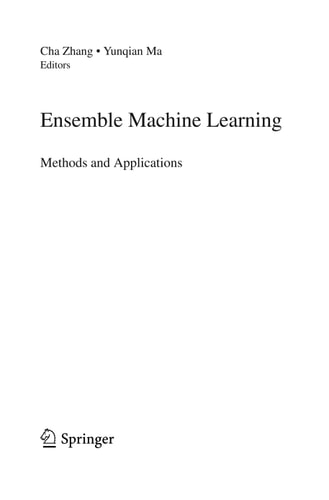
Ensemble Machine Learning
0
0
As an Amazon Associate and affiliate partner, Menrva Books earns from qualifying purchases. Learn more
Author Description
It is common wisdom that gathering a variety of views and inputs improves the process of decision making, and, indeed, underpins a democratic society. Dubbed “ensemble learning” by researchers in computational intelligence and machine learning, it is known to improve a decision system’s robustness and accuracy. Now, fresh developments are allowing researchers to unleash the power of ensemble learning in an increasing range of real-world applications. Ensemble learning algorithms such as “boosting” and “random forest” facilitate solutions to key computational issues such as face recognition and are now being applied in areas as diverse as object tracking and bioinformatics. Responding to a shortage of literature dedicated to the topic, this volume offers comprehensive coverage of state-of-the-art ensemble learning techniques, including the random forest skeleton tracking algorithm in the Xbox Kinect sensor, which bypasses the need for game controllers. At once a solid theoretical study and a practical guide, the volume is a windfall for researchers and practitioners alike.
Menrva's Summary
THE THESIS
The core principle of ensemble learning is that combining multiple diverse models yields superior predictive performance and robustness compared to any single model. This volume explores the theoretical underpinnings and practical applications of ensemble methods in machine learning. It details algorithms like boosting and random forests, demonstrating their utility in complex tasks such as face recognition, object tracking, and bioinformatics. The book aims to bridge the gap in existing literature by providing comprehensive coverage of cutting-edge techniques, including specific implementations like the random forest algorithm used in Xbox Kinect for skeleton tracking.
THE SCOPE MAP
- Comprehensive coverage of state-of-the-art ensemble learning techniques.
- Detailed explanations of algorithms such as boosting and random forest.
- Real-world applications in areas including face recognition, object tracking, and bioinformatics.
- Discussion of specific implementations, such as the random forest skeleton tracking algorithm in Xbox Kinect.
- Theoretical study combined with practical guidance for researchers and practitioners.
THE AUTHORITY PERSPECTIVE
This book is positioned as a valuable resource for both researchers and practitioners in the fields of computational intelligence and machine learning. The existing literature is noted as having a shortage of dedicated texts on ensemble learning, suggesting this volume aims to fill that gap. Its approach combines theoretical depth with practical application, making it suitable for those seeking to understand and implement these advanced techniques. The inclusion of specific, modern applications like the Xbox Kinect's skeleton tracking algorithm indicates a focus on contemporary relevance.
Page Count:
332
Publication Date:
2012-02-17
Publisher:
Springer Nature
ISBN-10:
1441993266
ISBN-13:
9781441993267
Science
Non-Fiction
Machine Learning
Computer Science
Data Science
Community Tags
Similar Books