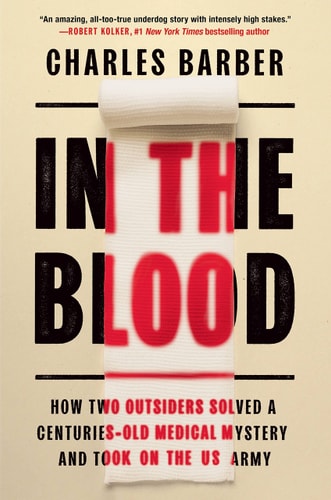
In the Blood: How Two Outsiders Solved a Centuries-Old Medical Mystery and Took on the US Army
0
0
As an Amazon Associate and affiliate partner, Menrva Books earns from qualifying purchases. Learn more
Author Description
2024 PEN America E.O. Wilson Literary Science Writing Award Finalist The "high-stakes" true story of how an absent-minded inventor and a down-on-his-luck salesman joined forces to create a once‑in‑a‑generation lifesaving product: "Suspenseful storytelling helps us see and feel the struggle and frustration, the sweat and tears... Inspiring" (Robert Kolker, #1 New York Times bestselling author of Hidden Valley Road). At the 1993 Battle of Mogadishu, dramatized by the popular film Black Hawk Down, the majority of soldiers who died were killed instantly or bled to death before they could reach an operating table. This tragedy reinforced the need for a revolutionary treatment that could transform trauma medicine. So, when Frank Hursey and Bart Gullong--who had no medical or military experience--discovered that a cheap, crushed rock called zeolite had blood‑clotting properties, they brought it to the military's attention. The Marines and the Navy adopted the resulting product, QuikClot, immediately. The Army, however, resisted. It had two products of its own being developed to prevent excessive bleeds, one of which had already cost tens of millions of dollars. The other, "Factor Seven," had a more dangerous complication: its side effects could be deadly. Unwilling to let its efforts end in failure--and led by the highly influential surgeon Colonel John Holcomb--the Army set out to smear QuikClot's reputation. Over the course of six years, Hursey and Gullong engaged in an epic struggle with Holcomb for recognition. Ultimately, a whistle‑blower inside the Army challenged the Army's embrace of Factor Seven, which resulted in a massive lawsuit led by the U.S. Department of Justice. The lawsuit focused further attention on the financial ties between the pharmaceutical company that produced Factor Seven and Holcomb's research institute. By withholding QuikClot--w
Menrva's Summary
THE THESIS
A medical breakthrough intended to save lives becomes the subject of a fierce battle between innovation and institutional resistance. Charles Barber recounts the true story of Frank Hursey and Bart Gullong, two individuals with no medical background, who discovered the blood-clotting properties of zeolite. Their subsequent development of QuikClot, a product that could revolutionize trauma medicine, brought them into direct conflict with the U.S. Army. The Army, invested in its own competing, and potentially dangerous, products like Factor Seven, actively worked to discredit QuikClot. This led to a six-year struggle for recognition, involving a whistleblower and a significant lawsuit spearheaded by the Department of Justice, which exposed financial ties between a pharmaceutical company and the Army's research institute.
THE SCOPE MAP
- The historical context of trauma medicine needs following the 1993 Battle of Mogadishu.
- The discovery of zeolite's blood-clotting properties by Hursey and Gullong.
- The development and adoption of QuikClot by the Marines and Navy.
- The U.S. Army's resistance to QuikClot, driven by its own product development and influential figures like Colonel John Holcomb.
- The six-year conflict between the inventors and the Army's established interests.
- The role of a whistleblower in challenging the Army's practices.
- The U.S. Department of Justice lawsuit and its focus on financial conflicts of interest.
THE AUTHORITY PERSPECTIVE
The book is recognized as a finalist for the 2024 PEN America E.O. Wilson Literary Science Writing Award, indicating critical acclaim for its scientific and literary merit. Reviewers highlight the suspenseful storytelling, which effectively conveys the struggles and triumphs of the inventors. The narrative is described as inspiring, drawing parallels to the popular film 'Black Hawk Down' and emphasizing the high-stakes nature of the true story. The reception suggests the book successfully balances the technical aspects of medical innovation with the dramatic human element of its pursuit.
Page Count:
281
Publication Date:
2023-01-01
Publisher:
Grand Central Publishing
ISBN-10:
1538709864
ISBN-13:
9781538709863
Biography
History
True Crime
Non-Fiction
Science
Community Tags
Similar Books














