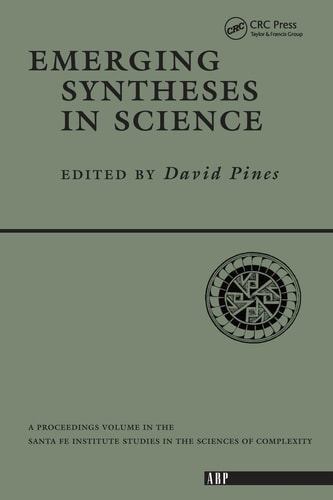
Emerging Syntheses in Science: Proceedings of the Founding Workshops of the Santa Fe Institute
0
0
As an Amazon Associate and affiliate partner, Menrva Books earns from qualifying purchases. Learn more
Author Description
Evolution of self-replicating macromolecules through natural selection is a dynamically ordered process. Two concepts are introduced to describe the physical regularity of macromolecular evolution: sequence space and quasi-species. Natural selection means localization of a mutant distribution in sequence space. This localized distribution, called the quasi-species, is centered around a master sequence (or a degenerate set), that the biologist would call the wild-type. The self-ordering of such a system is an essential consequence of its formation through self-reproduction of its macromolecular consti tuents, a process that in the dynamical equations expresses itself by positive diagonal coefficients called selective values. The theory describes how population numbers of wild type and mutants are related to the distribution of selective values, that is to say, how value topography maps into population topography. For selectively (nearly) neutral mutants appearing in the quasi- species distribution, population numbers are greatly enhanced as compared to those of disadvantageous mutants, even more so in continuous domains of such selectively valuable mutants. As a consequence, mutants far distant from the wild type may occur because they are produced with the help of highly populated, less distant precursors. Since values are cohesively distributed, like mountains on earth, and since their positions are multiply connected in the high-dimensional sequence space, the overpopulation of (nearly) neural mutants provides guidance for the evolutionary process. Localization in sequence space, subject to a threshold in the fidelity of reproduction, is steadily challenged until an optimal state is reached. The model has been designed according to experimentally determined properties of self-replicating molecules. The conclusions reached from the theoretical models can be used to construct machines that provide optimal conditions for the evolution of functional macromolecules.
Menrva's Summary
THE THESIS
This volume investigates the fundamental mechanisms governing the evolution of self-replicating macromolecules through the lens of dynamical systems and natural selection. David Pines, a distinguished physicist, compiles the foundational research from the Santa Fe Institute to establish a rigorous framework for understanding how molecular sequences organize into stable populations. The text argues that the physical regularity of evolution can be modeled by mapping selective values onto population topography, providing a mathematical basis for the emergence of complex biological order.
THE SCOPE MAP
What You Will Find
- Mathematical models of sequence space and quasi-species distribution.
- Analysis of selective values and their role in macromolecular self-ordering.
- Theoretical frameworks for the threshold of reproduction fidelity.
- Applications of evolutionary theory to the construction of functional macromolecular systems.
THE AUTHORITY PERSPECTIVE
Experts recognize this collection as a foundational text for those interested in the intersection of statistical physics and molecular biology. Readers frequently note the high level of technical density, as the prose assumes a strong background in dynamical systems and evolutionary theory.
Page Count:
252
Publication Date:
1988-01-01
Publisher:
CRC Press
ISBN-10:
0201156865
ISBN-13:
9780201156867
Science
Physics
Evolutionary Biology
Complexity Theory
Biology
Community Tags
Similar Books