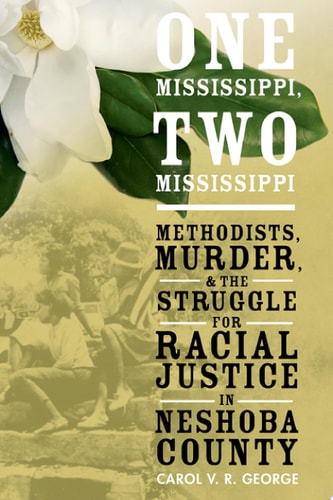
One Mississippi, Two Mississippi
0
0
As an Amazon Associate and affiliate partner, Menrva Books earns from qualifying purchases. Learn more
Author Description
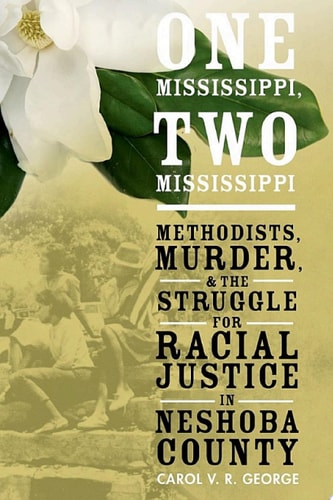
During Freedom Summer 1964, three young civil rights workers who were tasked with registering voters at Mt. Zion Methodist Church in Neshoba County, Mississippi were murdered there by law enforcement and Ku Klux Klansmen. The murders were hardly noticed in the area, so familiar had such violence become in the Magnolia State. For forty-one days the bodies of the three men lay undetected in a nearby dam, and for years afterward efforts to bring those responsible to justice were met only with silence. In One Mississippi, Two Mississippi, Carol V.R. George links the history of the Methodist Church (now the United Methodist Church), with newly-researched local history to show the role of this large denomination, important to both Blacks and Whites, in Mississippi's stumble toward racial justice. From 1930-1968, white Methodists throughout the church segregated their Black co-religionists, silencing Black ministers and many white ministers as well, locking their doors to all but their own members. Finally, the combination of civil rights activism and embarrassed Methodist morality persuaded the United Methodists to restore Black people to full membership. As the county and church integrated, volunteers from all races began to agitate for a new trial for the chief conspirator of the murders. In 2005, forty-one years after the killings, the accused was found guilty, his fate determined by local jurors who deliberated in a city ringed with casinos, unrecognizable to the old Neshoba. In one sense a spiritual history, the book is a microhistory of Mt. Zion Methodist Church and its struggles with white Neshoba, as a community learned that reconciliation requires a willingness to confront the past fully and truthfully. George draws on interviews with county residents, Black and white Methodist leaders, civil rights veterans, and those in civic groups, academia, and state government who are trying to carry the flag for reconciliation. George's sources--printed, oral, and material
Menrva's Summary
THE THESIS
This book investigates the intersection of institutional religious policy and local racial violence by examining the role of the Methodist Church in Mississippi's struggle for civil rights. Carol V. R. George, a historian, utilizes a microhistorical approach to analyze the Mt. Zion Methodist Church, documenting how the denomination's internal segregationist practices mirrored and reinforced the broader racial climate of the state between 1930 and 1968. The work argues that the eventual integration of the church was a necessary precursor to the broader social reconciliation that culminated in the 2005 conviction of the conspirators behind the 1964 Freedom Summer murders.
THE SCOPE MAP
What You Will Find
- A detailed microhistory of the Mt. Zion Methodist Church in Neshoba County.
- An analysis of the United Methodist Church's internal segregation policies from 1930 to 1968.
- Documentation of the 1964 Freedom Summer murders and the subsequent 2005 legal proceedings.
- Primary source interviews with civil rights veterans, local residents, and church leaders.
Scope Limits
- The book does not provide a comprehensive history of the entire American Civil Rights Movement.
- It does not offer a broad theological treatise on Methodism outside of its specific application to Mississippi racial politics.
THE AUTHORITY PERSPECTIVE
Scholars and historians recognize this work as a significant contribution to the study of religious institutions during the Civil Rights era. Readers frequently note the author's meticulous use of local oral histories to bridge the gap between national political narratives and specific community experiences.
Page Count:
320
Publication Date:
2015-01-01
Publisher:
Oxford University Press
ISBN-10:
0190231092
ISBN-13:
9780190231095
Religion
History
Civil Rights
Methodist Church
Social justice
Community Tags
Similar Books