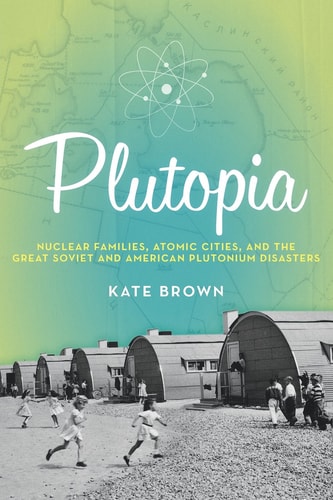
Plutopia: Nuclear Families, Atomic Cities, and the Great Soviet and American Plutonium Disasters
0
0
As an Amazon Associate and affiliate partner, Menrva Books earns from qualifying purchases. Learn more
Author Description
While many transnational histories of the nuclear arms race have been written, Kate Brown provides the first definitive account of the great plutonium disasters of the United States and the Soviet Union.In Plutopia, Brown draws on official records and dozens of interviews to tell the extraordinary stories of Richland, Washington and Ozersk, Russia-the first two cities in the world to produce plutonium. To contain secrets, American and Soviet leaders created plutopias--communities of nuclear families living in highly-subsidized, limited-access atomic cities. Fully employed and medically monitored, the residents of Richland and Ozersk enjoyed all the pleasures of consumer society, while nearby, migrants, prisoners, and soldiers were banned from plutopia--they lived in temporary "staging grounds" and often performed the most dangerous work at the plant. Brown shows that the plants' segregation of permanent and temporary workers and of nuclear and non-nuclear zones created a bubble of immunity, where dumps and accidents were glossed over and plant managers freely embezzled and polluted. In four decades, the Hanford plant near Richland and the Maiak plant near Ozersk each issued at least 200 million curies of radioactive isotopes into the surrounding environment--equaling four Chernobyls--laying waste to hundreds of square miles and contaminating rivers, fields, forests, and food supplies. Because of the decades of secrecy, downwind and downriver neighbors of the plutonium plants had difficulty proving what they suspected, that the rash of illnesses, cancers, and birth defects in their communities were caused by the plants' radioactive emissions. Plutopia was successful because in its zoned-off isolation it appeared to deliver the promises of the American dream and Soviet communism; in reality, it concealed disasters that remain highly unstable and threatening today.An untold and profoundly important piece of Cold War history, Plutopia invites readers to consider the nuc
Menrva's Summary
THE THESIS
How did the creation of isolated, subsidized 'plutopias' in the United States and the Soviet Union facilitate massive environmental contamination while maintaining public compliance? Kate Brown, a professor of history, utilizes declassified government records and extensive oral history interviews to analyze the parallel development of Richland, Washington, and Ozersk, Russia. She argues that the deliberate segregation of permanent residents from temporary workers created a false sense of security that allowed plant managers to conceal catastrophic radioactive leaks and systemic corruption for decades.
THE SCOPE MAP
What You Will Find
- Comparative analysis of the Hanford site in the U.S. and the Maiak plant in Russia.
- Examination of the socioeconomic structures of 'atomic cities' and their impact on public perception.
- Documentation of radioactive isotope release levels and their long-term ecological consequences.
Scope Limits
- The text does not provide a comprehensive technical manual on plutonium production processes.
- It does not focus on the global geopolitical strategy of the nuclear arms race beyond its impact on these two specific communities.
THE AUTHORITY PERSPECTIVE
Historians and environmental scholars frequently cite this work as a definitive comparative study of Cold War industrial disasters. Readers often note the meticulous research and the chilling clarity with which the author exposes the human cost of state-sponsored secrecy.
Page Count:
416
Publication Date:
2015-08-01
Publisher:
Oxford University Press
ISBN-10:
0190233109
ISBN-13:
9780190233105
History
United States
American History
Working class
Sociology
Cold War
history russia
State History
Nuclear Energy
Community Tags
Similar Books