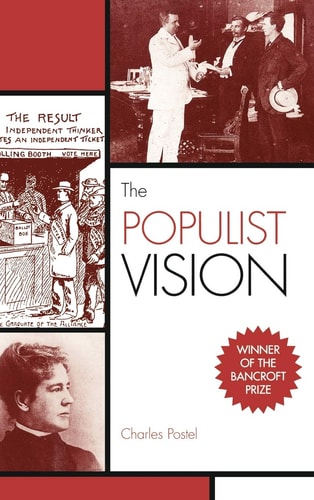
The Populist Vision
0
0
As an Amazon Associate and affiliate partner, Menrva Books earns from qualifying purchases. Learn more
Author Description
In the late nineteenth century, monumental technological innovations like the telegraph and steam power made America and the world a much smaller place. New technologies also made possible large-scale organization and centralization. Corporations grew exponentially and the rich amassed great fortunes. Those on the short end of these wrenching changes responded in the Populist revolt, one of the most effective challenges to corporate power in American history.But what did Populism represent? Half a century ago, scholars such as Richard Hofstadter portrayed the Populist movement as an irrational response of backward-looking farmers to the challenges of modernity. Since then, the romantic notion of Populism as the resistance movement of tradition-based and pre-modern communities to a modern and commercial society has prevailed. In a broad, innovative reassessment, based on a deep reading of archival sources, The Populist Vision argues that the Populists understood themselves as--and were in fact--modern people, who pursued an alternate vision for modern America.Taking into account both the leaders and the led, The Populist Vision uses a wide lens, focusing on the farmers, both black and white, men and women, while also looking at wager workers and bohemian urbanites. From Texas to the Dakotas, from Georgia to California, farmer Populists strove to use the new innovations for their own ends. They sought scientific and technical knowledge, formed highly centralized organizations, launched large-scale cooperative businesses, and pressed for reforms on the model of the nation's most elaborate bureaucracy - the Postal Service. Hundreds of thousands of Populist farm women sought education, employment in schools and offices, and a more modern life. Miners, railroad workers, and other labor Populists joined with farmers to give impetus to the regulatory state. Activists from Chicago, San Francisco, and other new cities provided Populism with a dynamic urban dimension.
Menrva's Summary
THE THESIS
The Populist Vision investigates the core question of whether the nineteenth-century Populist movement was a regressive reaction to modernity or a sophisticated, forward-looking attempt to harness modern systems for democratic ends. Charles Postel, a historian specializing in American social and political movements, utilizes extensive archival research to challenge the long-standing academic consensus that Populists were merely anti-modern traditionalists. By analyzing the movement's internal organizational structures and its embrace of scientific and bureaucratic reform, Postel argues that Populists were active participants in the modernization of the United States who sought to democratize the corporate and technological advancements of their era.
THE SCOPE MAP
What You Will Find
- A comprehensive analysis of the Populist movement's organizational strategies, including the formation of large-scale cooperatives and bureaucratic reform efforts.
- Examination of the diverse demographics within the movement, covering farmers, wage workers, and urban activists across various American regions.
- Evidence derived from deep archival research, including personal accounts, organizational records, and contemporary political literature.
- A thematic focus on the intersection of technological innovation, corporate centralization, and the pursuit of a regulatory state.
THE AUTHORITY PERSPECTIVE
Historians and political scientists frequently cite this work as a significant revisionist text that successfully reframes the Populist movement within the context of American modernization. Experts highlight the author's meticulous use of primary sources to dismantle outdated interpretations, noting that the prose remains accessible while maintaining rigorous academic standards.
Page Count:
397
Publication Date:
2007-05-15
Publisher:
Oxford University Press
ISBN-10:
0195176502
ISBN-13:
9780195176506
History
Economics
Populism
United States
Working class
American History
Sociology
Farmers
Community Tags
Other Editions(2)

Similar Books















Reader Comments
Share Your Thoughts
No comments yet. Be the first to share your thoughts!