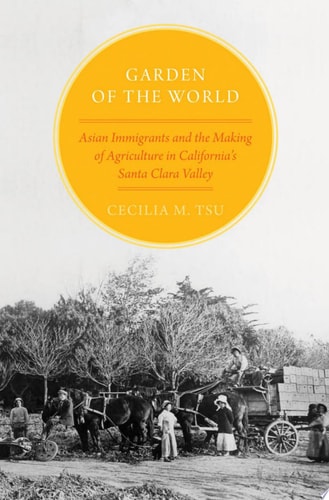
Garden of the World: Asian Immigrants and the Making of Agriculture in California's Santa Clara Valley
0
0
As an Amazon Associate and affiliate partner, Menrva Books earns from qualifying purchases. Learn more
Author Description
Nearly a century before it became known as Silicon Valley, the Santa Clara Valley was world-renowned for something else: the succulent fruits and vegetables grown in its fertile soil. In Garden of the World, Cecilia Tsu tells the overlooked, intertwined histories of the Santa Clara Valley's agricultural past and the Asian immigrants who cultivated the land during the region's peak decades of horticultural production. Weaving together the story of three overlapping waves of Asian migration from China, Japan, and the Philippines in the nineteenth and twentieth centuries, Tsu offers a comparative history that sheds light on the ways in which Asian farmers and laborers fundamentally altered the agricultural economy and landscape of the Santa Clara Valley, as well as white residents' ideas about race, gender, and what it meant to be an American family farmer.At the heart of American racial and national identity in the nineteenth and twentieth centuries was the family farm ideal: the celebration of white European-American families operating independent, self-sufficient farms that would contribute to the stability of the nation. In California by the 1880s, boosters promoted orchard fruit growing as one of the most idyllic incarnations of the family farm ideal and the lush Santa Clara Valley the finest location to live out this agrarian dream. But in practice, many white growers relied extensively on hired help, which in the late nineteenth and early twentieth centuries was largely Asian. Detailing how white farmers made racial and gendered claims to defend their dependence on nonwhite labor, how those claims shifted with the settlement of each Asian immigrant group, and how Chinese, Japanese, and Filipinos sought to create their own version of the American dream in farming, Tsu excavates the social and economic history of agriculture in this famed rural community to reveal the intricate nature of race relations there.
Menrva's Summary
THE THESIS
This book investigates how Asian immigrant labor and farming practices fundamentally shaped the agricultural development and racial identity of California's Santa Clara Valley during the nineteenth and twentieth centuries. Cecilia M. Tsu, a historian specializing in Asian American history, utilizes archival records and regional case studies to challenge the traditional narrative of the white family farm ideal. She argues that the economic success of the region relied heavily on Chinese, Japanese, and Filipino laborers, whose presence forced white residents to constantly renegotiate their definitions of race, gender, and national belonging.
THE SCOPE MAP
What You Will Find
- A comparative analysis of three distinct waves of Asian migration from China, Japan, and the Philippines.
- An examination of the 'family farm ideal' as a tool for constructing white racial and national identity.
- Historical documentation of labor practices in the Santa Clara Valley's orchard fruit industry.
- Insights into how immigrant farmers navigated systemic discrimination to pursue their own versions of the American dream.
THE AUTHORITY PERSPECTIVE
Scholars and historians recognize this work as a significant contribution to the study of labor and race in the American West. Readers frequently note the depth of the archival research and the clarity with which Tsu connects local agricultural history to broader national identity debates.
Page Count:
298
Publication Date:
2013-01-01
Publisher:
Oxford University Press
ISBN-10:
0199910626
ISBN-13:
9780199910625
History
Sociology
Fruit Trade
Labor history
California history
United States
Agriculture
American History
Community Tags
Other Editions(2)

Similar Books






Reader Comments
Share Your Thoughts
No comments yet. Be the first to share your thoughts!