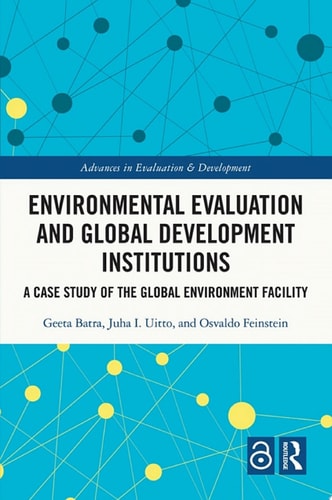
Environmental Evaluation and Global Development Institutions: A Case Study of the Global Environment Facility
0
0
As an Amazon Associate and affiliate partner, Menrva Books earns from qualifying purchases. Learn more
Author Description
Evaluation is increasingly important for finding sustainable solutions for the people and the planet, based on a systematic analysis of what works, for whom, and under what circumstances, and to contribute to the achievement of the Sustainable Development Goals, as they pertain to the environment. This book explores why the Global Environment Facility (GEF) invests in evaluation for accountability and learning to inform its decision-making on programming priorities, and how this leads to wiser funding decisions and better program performance on the ground. The book is based on real-life experiences of how to make evaluation count for international environmental action. Drawing upon comprehensive evaluations of the GEF, it provides unique insights from authors responsible for designing, implementing, and disseminating the findings of the evaluations. No other multilateral development or environment agency places evaluation fully at the center of their decision-making. The book outlines the trends in the global environment and the changing landscape of international environmental finance. It defines the role of the GEF and explains its institutional framework and the unique partnership that involves donor and recipient countries, multilateral development banks, UN agencies, nongovernmental organizations (NGOs), and national agencies in the developing countries. Further, it provides useful pointers to other organizations wishing to enhance evidence-based decision-making for improving their relevance, performance, and impact. The book will be most suitable for graduate-level, specialized study in a variety of disciplines such as environmental and development economics, political science, international relations, geography, sociology, and social anthropology. The Open Access version of this book, available at http://www.taylorfrancis.com, has been made available under a Creative Commons Attribution-Non Commercial-No Derivatives 4.0 license.
Menrva's Summary
THE THESIS
This book investigates the critical role of evaluation within international development institutions, specifically focusing on the Global Environment Facility (GEF). The authors explore how the GEF leverages evaluation for accountability and learning, aiming to inform programming priorities and enhance decision-making for more effective environmental action. Drawing on real-life experiences and comprehensive evaluations, the book details the GEF's unique institutional framework, its partnerships, and the trends in global environmental finance. It offers insights for other organizations seeking to improve evidence-based decision-making and impact.
THE SCOPE MAP
- The importance of evaluation for sustainable development and achieving environmental Sustainable Development Goals.
- The GEF's investment in evaluation for accountability and learning.
- How evaluation informs GEF's decision-making on programming priorities and leads to wiser funding decisions.
- Real-life experiences demonstrating the impact of evaluation on international environmental action.
- Insights from authors involved in designing, implementing, and disseminating evaluation findings.
- An outline of trends in the global environment and international environmental finance.
- A definition of the GEF's role, its institutional framework, and its partnerships.
THE AUTHORITY PERSPECTIVE
The book is positioned as a specialized study suitable for graduate-level students in fields such as environmental and development economics, political science, international relations, geography, sociology, and social anthropology. Its focus on the Global Environment Facility's use of evaluation suggests a detailed examination of institutional practices and their impact on environmental finance and programming. The authors' direct involvement in the GEF's evaluation processes indicates a perspective grounded in practical experience and internal knowledge, likely offering unique insights into evidence-based decision-making within multilateral organizations.
Page Count:
200
Publication Date:
2021-10-10
Publisher:
Routledge
ISBN-10:
1000481999
ISBN-13:
9781000481990
Politics
Non-Fiction
Economics
Public Policy
International relations
Evaluation
Community Tags
Other Editions(2)
Similar Books













Reader Comments
Share Your Thoughts
No comments yet. Be the first to share your thoughts!