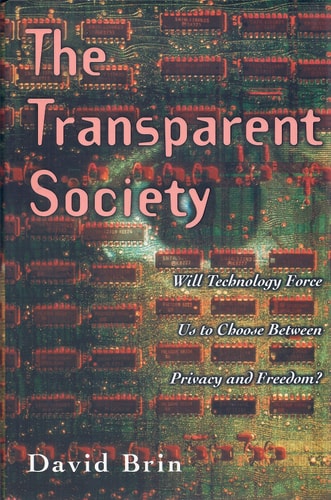
The Transparent Society: Will Technology Force Us to Choose Between Privacy and Freedom?
0
0
As an Amazon Associate and affiliate partner, Menrva Books earns from qualifying purchases. Learn more
Author Description
In New York and Baltimore, police cameras scan public areas twenty-four hours a day. Huge commercial databases track you finances and sell that information to anyone willing to pay. Host sites on the World Wide Web record every page you view, and “smart” toll roads know where you drive. Every day, new technology nibbles at our privacy.Does that make you nervous? David Brin is worried, but not just about privacy. He fears that society will overreact to these technologies by restricting the flow of information, frantically enforcing a reign of secrecy. Such measures, he warns, won't really preserve our privacy. Governments, the wealthy, criminals, and the techno-elite will still find ways to watch us. But we'll have fewer ways to watch them. We'll lose the key to a free society: accountability. The Transparent Society is a call for “reciprocal transparency.” If police cameras watch us, shouldn't we be able to watch police stations? If credit bureaus sell our data, shouldn't we know who buys it? Rather than cling to an illusion of anonymity-a historical anomaly, given our origins in close-knit villages-we should focus on guarding the most important forms of privacy and preserving mutual accountability. The biggest threat to our freedom, Brin warns, is that surveillance technology will be used by too few people, now by too many.A society of glass houses may seem too fragile. Fearing technology-aided crime, governments seek to restrict online anonymity; fearing technology-aided tyranny, citizens call for encrypting all data. Brins shows how, contrary to both approaches, windows offer us much better protection than walls; after all, the strongest deterrent against snooping has always been the fear of being spotted. Furthermore, Brin argues, Western culture now encourages eccentricity-we're programmed to rebel! That gives our society a natural protection against error and wrong-doing, like a body's immune system. But “social T-cells” need openness to spot trouble and get t
Menrva's Summary
THE THESIS
Does the rise of ubiquitous surveillance technology necessitate a trade-off between individual privacy and societal freedom? David Brin, an author and scientist, examines the erosion of anonymity in the digital age and argues that attempting to enforce secrecy is a futile endeavor that ultimately empowers the powerful. He proposes a framework of reciprocal transparency, suggesting that accountability is best maintained when citizens possess the same technological capabilities to monitor institutions as those institutions have to monitor the public.
THE SCOPE MAP
What You Will Find
- Analysis of surveillance infrastructure including public cameras, commercial databases, and web tracking.
- The concept of reciprocal transparency as a mechanism for democratic accountability.
- Examination of the historical context of privacy versus the modern digital reality.
- Arguments regarding the role of eccentricity and social openness in preventing institutional tyranny.
THE AUTHORITY PERSPECTIVE
Critics and readers often note that Brin provides a provocative, counter-intuitive argument that challenges traditional privacy advocacy. Experts frequently highlight the text as a foundational, if controversial, contribution to the discourse on digital ethics and the future of civil liberties.
Page Count:
384
Publication Date:
1998-05-17
Publisher:
Addison-Wesley
ISBN-10:
020132802X
ISBN-13:
9780201328028
Non-Fiction
Politics
Freedom Of Information
Technology
Sociology
Privacy
Community Tags
Similar Books