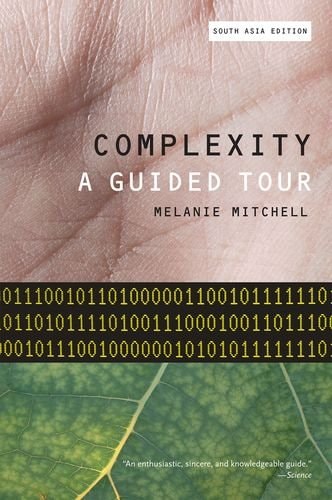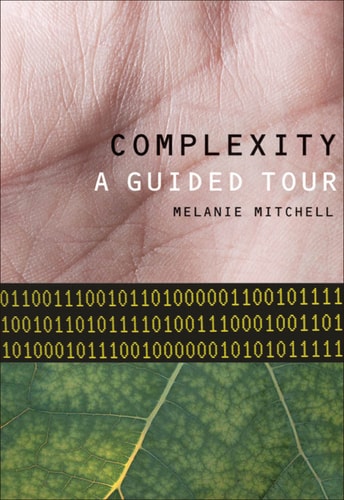
Complexity: A Guided Tour
0
0
As an Amazon Associate and affiliate partner, Menrva Books earns from qualifying purchases. Learn more
Author Description
What enables individually simple insects like ants to act with such precision and purpose as a group? How do trillions of neurons produce something as extraordinarily complex as consciousness? In this remarkably clear and companionable book, leading complex systems scientist Melanie Mitchell provides an intimate tour of the sciences of complexity, a broad set of efforts that seek to explain how large-scale complex, organized, and adaptive behavior can emerge from simple interactions among myriad individuals. Based on her work at the Santa Fe Institute and drawing on its interdisciplinary strategies, Mitchell brings clarity to the workings of complexity across a broad range of biological, technological, and social phenomena, seeking out the general principles or laws that apply to all of them. Richly illustrated, Complexity: A Guided Tour--winner of the 2010 Phi Beta Kappa Book Award in Science--offers a wide-ranging overview of the ideas underlying complex systems science, the current research at the forefront of this field, and the prospects for its contribution to solving some of the most important scientific questions of our time.
Menrva's Summary
THE THESIS
How do large-scale, organized, and adaptive behaviors emerge from simple interactions among myriad individual components? Melanie Mitchell, a professor at the Santa Fe Institute, investigates this fundamental question by synthesizing interdisciplinary research from biology, physics, and computer science. She presents a framework for understanding complex systems, arguing that despite their diverse manifestations, these systems share underlying principles that govern their self-organization and evolution.
THE SCOPE MAP
What You Will Find
- Analysis of emergent phenomena in biological systems, such as ant colonies and neural networks.
- Exploration of computational models, including cellular automata and genetic algorithms.
- Examination of the history and development of complex systems science as a field.
- Discussion of the theoretical challenges in defining and measuring complexity across different scales.
THE AUTHORITY PERSPECTIVE
Experts and readers alike recognize this work as a foundational, accessible introduction to the field of complex systems. While the subject matter is inherently technical, the prose is noted for its clarity and ability to distill dense interdisciplinary research for a general audience.
Page Count:
356
Publication Date:
2009-01-01
Publisher:
Oxford University Press
ISBN-10:
0199741026
ISBN-13:
9780199741021
History
Science
Computer Science
Earth Sciences
Mathematics
Complexity Theory
Biology
Physics
Complexity Philosophy
Systems Science