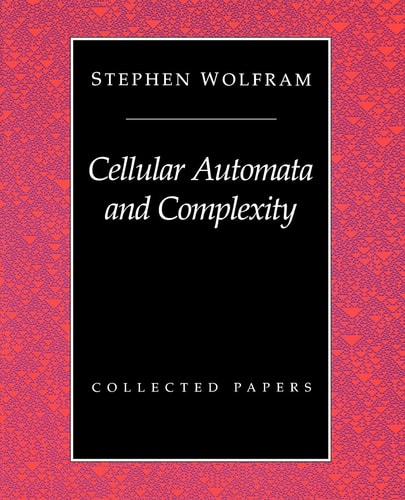
Cellular Automata and Complexity: Collected Papers
0
0
As an Amazon Associate and affiliate partner, Menrva Books earns from qualifying purchases. Learn more
Author Description
Are mathematical equations the best way to model nature? For many years it had been assumed that they were. But in the early 1980s, Stephen Wolfram made the radical proposal that one should instead build models that are based directly on simple computer programs. Wolfram made a detailed study of a class of such models known as cellular automata, and discovered a remarkable fact: that even when the underlying rules are very simple, the behavior they produce can be highly complex, and can mimic many features of what we see in nature. And based on this result, Wolfram began a program of research to develop what he called?A Science of Complexity.?The results of Wolfram's work found many applications, from the so-called Wolfram Classification central to fields such as artificial life, to new ideas about cryptography and fluid dynamics. This book is a collection of Wolfram's original papers on cellular automata and complexity. Some of these papers are widely known in the scientific community; others have never been published before. Together, the papers provide a highly readable account of what has become a major new field of science, with important implications for physics, biology, economics, computer science and many other areas.
Menrva's Summary
THE THESIS
Can simple computer programs, rather than traditional mathematical equations, provide a more accurate model for the complexity observed in the natural world? Stephen Wolfram, a pioneer in computational science, presents a collection of his foundational research papers that challenge the reliance on classical calculus-based modeling. By examining cellular automata, Wolfram argues that complex systems emerge from simple, discrete rules, establishing a framework for a new science of complexity that spans physics, biology, and economics.
THE SCOPE MAP
What You Will Find
- The development and application of the Wolfram Classification system for cellular automata.
- Theoretical explorations into the intersection of computational rules and natural phenomena.
- Original research papers detailing the transition from traditional mathematics to program-based modeling.
- Interdisciplinary implications for fields including cryptography, fluid dynamics, and artificial life.
THE AUTHORITY PERSPECTIVE
Experts recognize this collection as a foundational text for understanding the origins of complexity theory and computational modeling. Readers frequently note the technical density of the prose, which serves as a primary source for researchers interested in the history and development of Wolfram's scientific paradigm.
Page Count:
608
Publication Date:
2002-07-01
Publisher:
CRC Press
ISBN-10:
0201626640
ISBN-13:
9780201626643
Science
Mathematics
Physics
Computer Science
Computational complexity
Complexity Theory